
Archon Setup Guide
Complete steps to integrate the Archon framework into a new project. Archon's reusable mechanisms are project-agnostic and platform-agnostic; each adopter still fills project-state files under
.archon/.
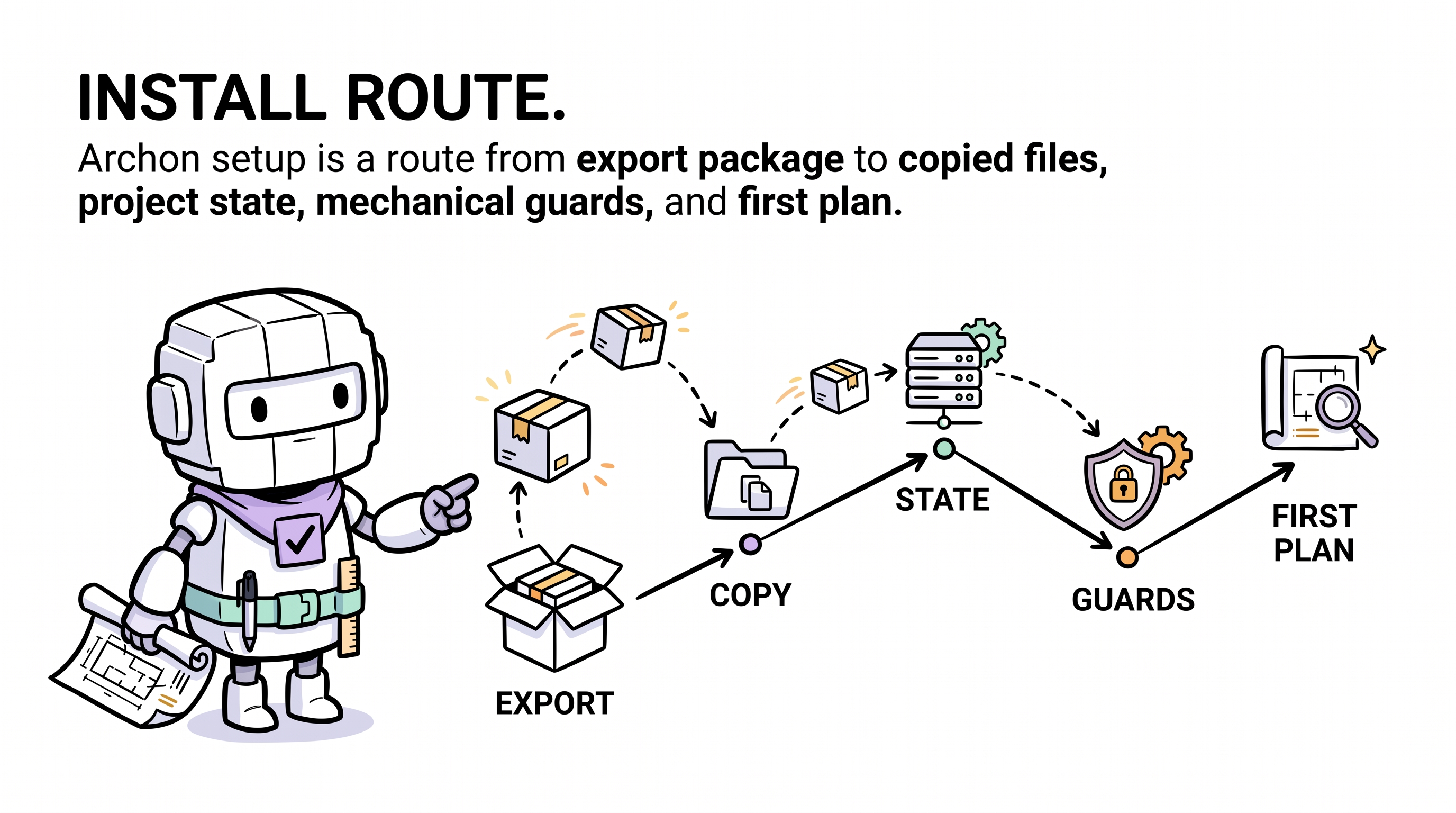
Setup has one route: export or copy the framework, fill project state, install mechanical guards, then run the first plan to prove the agent can load the right context.
Prerequisites
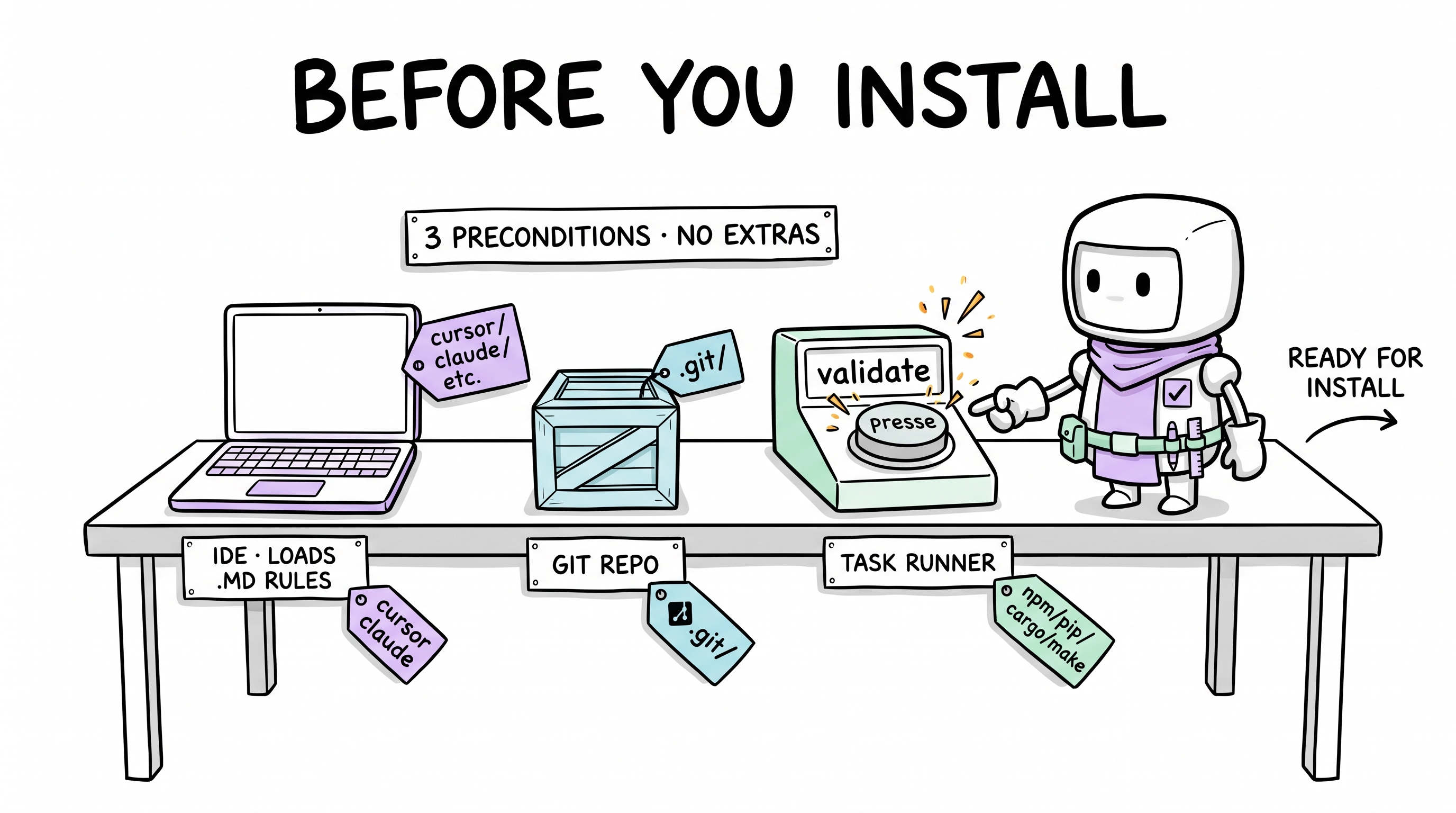
- An AI coding platform that loads markdown-based rules, skills, and commands (Cursor, Claude Code, or equivalent)
- Git repository (Archon relies on git hooks and version history)
- A task runner / package manager capable of registering a single validation command (npm, pip, cargo, make, etc.)
Reference implementation note: the test harness in §3b and the pre-commit script in §3c below use Node.js + Vitest + Husky for concreteness. Every mechanism is portable — equivalent ports to pytest / cargo test / go test are welcome.
Directory Convention
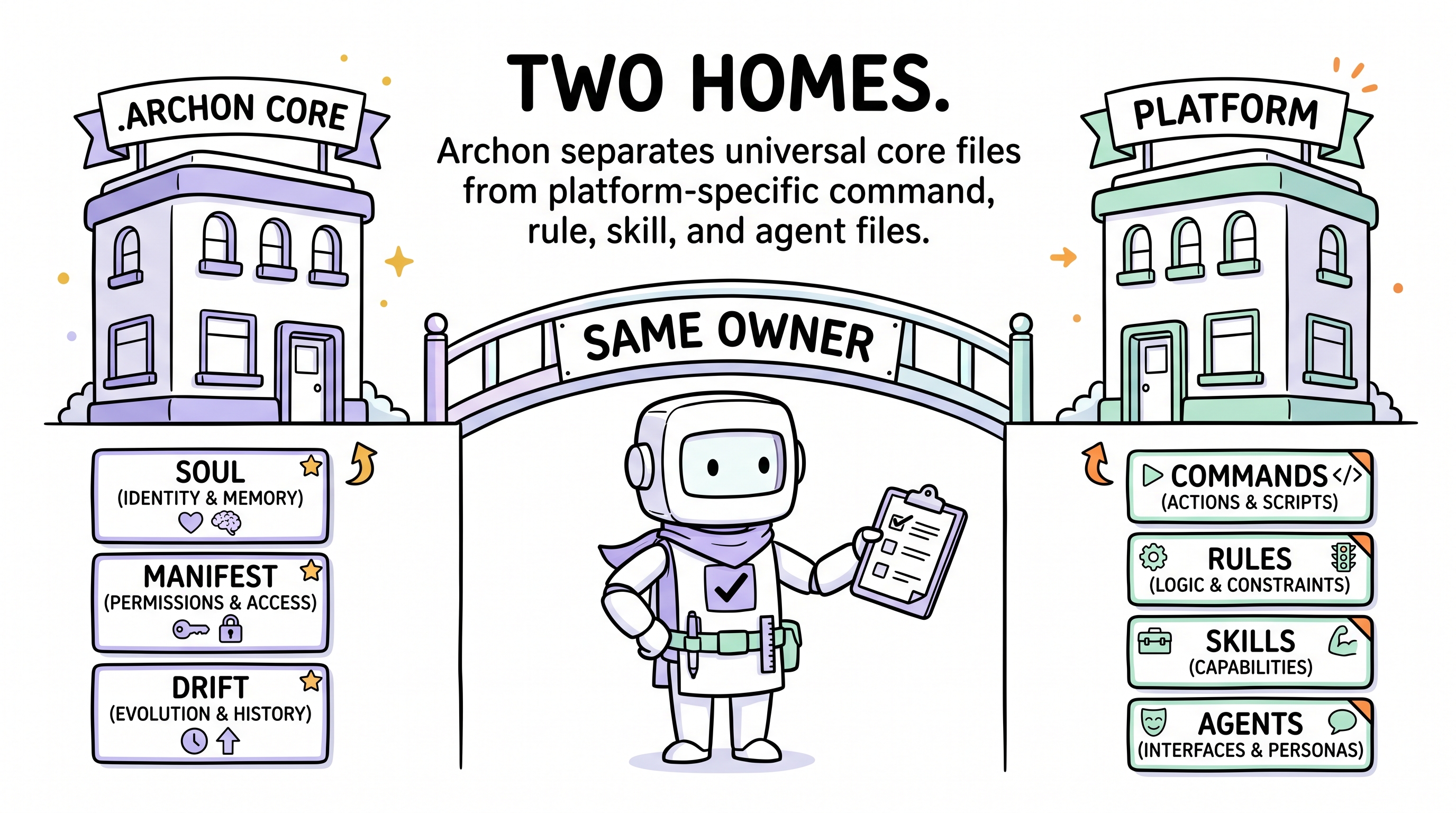
Archon uses a two-tier directory structure:
| Category | Directory | Note |
|---|---|---|
| Core + project state files | .archon/ | soul and portable helpers plus project state (manifest, drift, debt, memos, decisions), optional extensions & dashboard — same path across platforms |
| Platform files | .cursor/ or .claude/ etc. | commands, agents, rules, skills — auto-loaded by platform |
| Platform | Platform Directory | Rule Format |
|---|---|---|
| Cursor | .cursor/ | .mdc (YAML frontmatter + Markdown) |
| Claude Code | .claude/ | .md (Markdown) |
Below, {platform}/ denotes the platform directory (e.g., .cursor/ or .claude/). .archon/ is the same path on all platforms.
Cross-Reference Convention
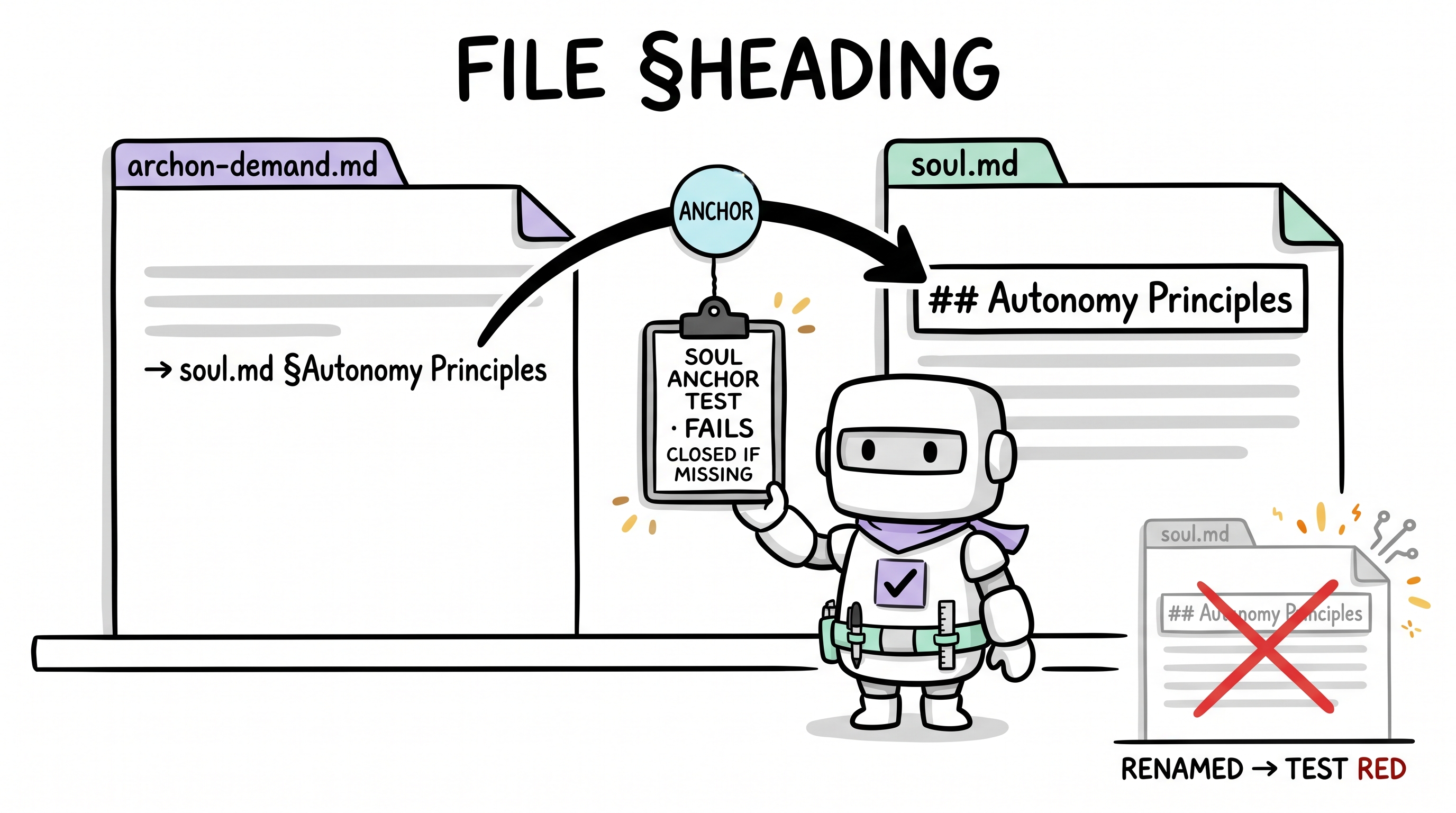
Archon files reference each other via the <file> §<heading> syntax:
soul.md §Autonomy Principles
soul/delivery.md §Reasoning Capsules
manifest.md §Context Budget
archon-demand §Decision GateThe § character binds to a literal H2–H6 heading in the target file. Every such reference is mechanically validated by the Soul Anchor Consistency test (see §3b Block 4). Renaming a referenced heading fails the validation command until every citer is updated.
Optional: Export a Standalone Reuse Package (Zero Impact on Current Project)
If you're inside the Archon authoring source repo and want to generate a standalone reuse package for other projects:
# Cursor target (default)
npm run archon:export -- ./archon-standalone --overwrite

# Claude Code target
npm run archon:export -- ./archon-standalone --platform=claude-code --overwriteThe export directory will contain:
- Project-agnostic core:
soul+domain-lenses(including authoring templates) +commands+agents+ decoupling rules + core skills (archon-framework,archon-git-commit,blink-dispatch,external-agent-patterns) - Project templates:
manifest.md+drift.md+debt.md+memos.md+.archon/decisions.md - Portable governance and run-state helpers:
.archon/contracts/governance-contract.yaml+scripts/archon-check.py+scripts/archon-check.sh+scripts/archon-run-state.mjs+scripts/archon-records.mjs(ADR-22 records-folder regenerator for drift / memos / debt hot summaries) - Bundled documentation:
docs/archon/README.md+architecture.md+setup.md(this file) +decisions.md+ run-state schema/templates - Commit hook scaffold:
.husky/pre-commit - Platform entry point (Claude Code generates
CLAUDE.md)
Then copy the export directory contents to the target project root and continue with the setup steps below.
Export Source-of-Truth Matrix
When changing what Archon exports, update the source that owns that question first:
| Question | Source of Truth | Checked By |
|---|---|---|
| Which source files are copied into the standalone kit? | scripts/export-archon-core.mjs | Export smoke test + export-manifest contract |
| Which portable baseline files must every adopter receive? | .archon/contracts/governance-contract.yaml export_manifest.required_files | scripts/archon-check.py + export-manifest contract |
| What does a human installer expect to see? | docs/archon/setup.md export summary + Step 1 tree | export-manifest contract |
| What does the agent read first to understand the framework? | {platform}/skills/archon-framework/SKILL.md | primer export/routing contract |
Do not add a shipped artifact only to prose. Add it to the export script first, add it to the governance contract when it is part of the portable baseline, then update the adopter-facing docs and tests.
Step 1: Copy Framework Files
The following files are project-agnostic — copy directly from the export package or an existing Archon project:
.archon/                              ← Archon core + project state (same path across platforms)
├── soul.md                           ← Cognitive core (hot-path sections: identity, axioms, guardrails, evolution)
├── soul/
│   ├── delivery.md                   ← Delivery-mode extension (loaded by /archon-demand)
│   └── review.md                     ← Review-mode extension (loaded by /archon-plan, /archon-review)
├── domain-lenses/                    ← Domain Lens pre-Verdict index + proceed-only lens/tool contracts
│   ├── registry.yaml                 ← Single index for lens/tool membership, discovery metadata, and budgets
│   ├── lenses/                       ← Lens contracts (installed: dev + platform + ecosystem + capability + design)
│   ├── tools/                        ← Atomic tool cards scoped to one lens
│   └── templates/                    ← Lens/tool authoring skeletons for new domains
│       ├── lens.md                   ← Lens contract template
│       └── tool.md                   ← Atomic tool card template
└── (manifest.md · drift.md · debt.md · memos.md · decisions.md created in Step 2)
{platform}/                           ← Platform-specific files
├── commands/
│   ├── archon.md                     ← Unified entry (wake + intent routing)
│   ├── archon-plan.md                ← Planning mode
│   ├── archon-demand.md              ← Delivery mode (Decision Gate → self-directed execution → Validation Gate → Close-Out)
│   ├── archon-review.md              ← Full review mode
│   └── archon-dashboard.md           ← Governance dashboard launcher (optional; dashboard itself activated in Step 4)
├── agents/
│   ├── archon-reviewer.md            ← Full review sub-agent
│   └── archon-capture-auditor.md     ← Post-delivery audit sub-agent
├── rules/
│   ├── archon.mdc (.md)              ← Decoupling rules (what may / may not go in each file)
│   └── archon-wake.mdc (.md)         ← Wake trigger — "hi archon" natural-language activation; also routes the agent to the primer skill on first use
└── skills/
    ├── archon-framework/SKILL.md     ← Agent primer — framework self-introduction loaded on demand
    ├── archon-git-commit/SKILL.md    ← Commit-gate skill — reads Run-State v2 or legacy .archon/run.md before any commit
    ├── blink-dispatch/SKILL.md       ← Thin-slice subagent dispatch gate — decides skip vs use:<subagent>
    └── external-agent-patterns/SKILL.md ← External-framework evaluation skill — checks role assumptions before borrowing patterns
.archon/contracts/governance-contract.yaml  ← Portable governance contract shared by reference checkers and authoring tests
scripts/archon-check.py               ← Dependency-free Python reference checker for non-TS adopters
scripts/archon-check.sh               ← POSIX shell wrapper around the Python checker
scripts/archon-run-state.mjs           ← Dependency-free Run-State v2 helper (init/set/check/commit resolution)
scripts/archon-records.mjs ← Dependency-free records-folder regenerator (ADR-22; new/regen/check for drift|memos|debt)Per-delivery ephemeral state:
.archon/runs/<run_id>/state.json       ← Run-State v2 per-delivery state (activated after Verdict, removed after successful commit)
.archon/runs/<run_id>/events.ndjson    ← Append-only event trace for debugging/resume
.archon/run.md                         ← Legacy single-file fallback during migration
.archon/templates/run-state.schema.json ← Schema reference for Run-State v2
.archon/templates/run.template.md ← Legacy schema reference for .archon/run.mdClaude Code extra: Place
CLAUDE.mdat the project root containing Archon boot instructions and command index (auto-generated by the export script).
What each rule does
archon-wake.mdcis an always-applied rule (~20 lines). It detects the natural-language wake phrase (hi archon …), hot-path reads the requiredsoul.mdidentity/routing sections andmanifest.mdcurrent-state sections, then routes the trailing text into thearchoncommand. Without this rule, users would need to type/archon-*commands explicitly every time.archon.mdcis the decoupling rule. It separates project-state files (manifest.md, drift logs, debt, memos, project ADRs) from universal framework files. Editor rules surface violations during editing; review sub-agents audit them afterward.archon-framework/SKILL.mdis the agent-facing primer. Loaded on demand when the agent: (a) first encounters an Archon-governed project, (b) is about to modify any archon file, (c) is about to extend Archon with a new rule/skill/extension/ADR, or (d) is asked "what is Archon / how does this work?".archon-git-commit/SKILL.mdis the commit-gate skill. Loaded when the user asks for a commit during an active Archon delivery. It resolves Run-State v2 first (.archon/runs/<run_id>/state.json), falls back to legacy.archon/run.md, asserts the permit flag and every SOP variable is complete, then generates a Conventional Commits message and invokes git. Delegates to a plaingit-commitskill when no active run-state exists.blink-dispatch/SKILL.mdis the close-out subagent dispatch gate. It thin-slices the diff and emitssubagent_dispatch: skip:<reason> | use:<subagent>:<reason>before any subagent is launched..archon/domain-lenses/provides the optional Domain Lens protocol used by/archon-demandwhen installed: classify one lens from registry metadata, read the selected lens router, load a bounded atomic tool set, and decompose multi-domain demands instead of mixing identities. The description index lives at.archon/domain-lenses/registry.yaml.
Domain Lenses vs Extensions
Use this rule when adapting Archon:
| Need | Mechanism |
|---|---|
| Professional focus, reusable capability routing, or domain toolkit (PM, QA, development, design, planning, architecture, creative, art) | .archon/domain-lenses/ |
| Lifecycle hook (pre-scan, close-out, review, dashboard, demand-pool, project-local workflow) | .archon/extensions/ |
If the capability changes how Archon thinks about one demand, add a Domain Lens. If it changes when Archon runs extra lifecycle behavior, add an Extension.
When adding a Domain Lens, follow .archon/domain-lenses/README.md §Adding a Domain: registry entry and tool_index metadata first, then lens contract, then atomic tools. A normal new domain should pass the existing Domain Lens contract tests without adding custom test logic.
Step 2: Create Project State Files
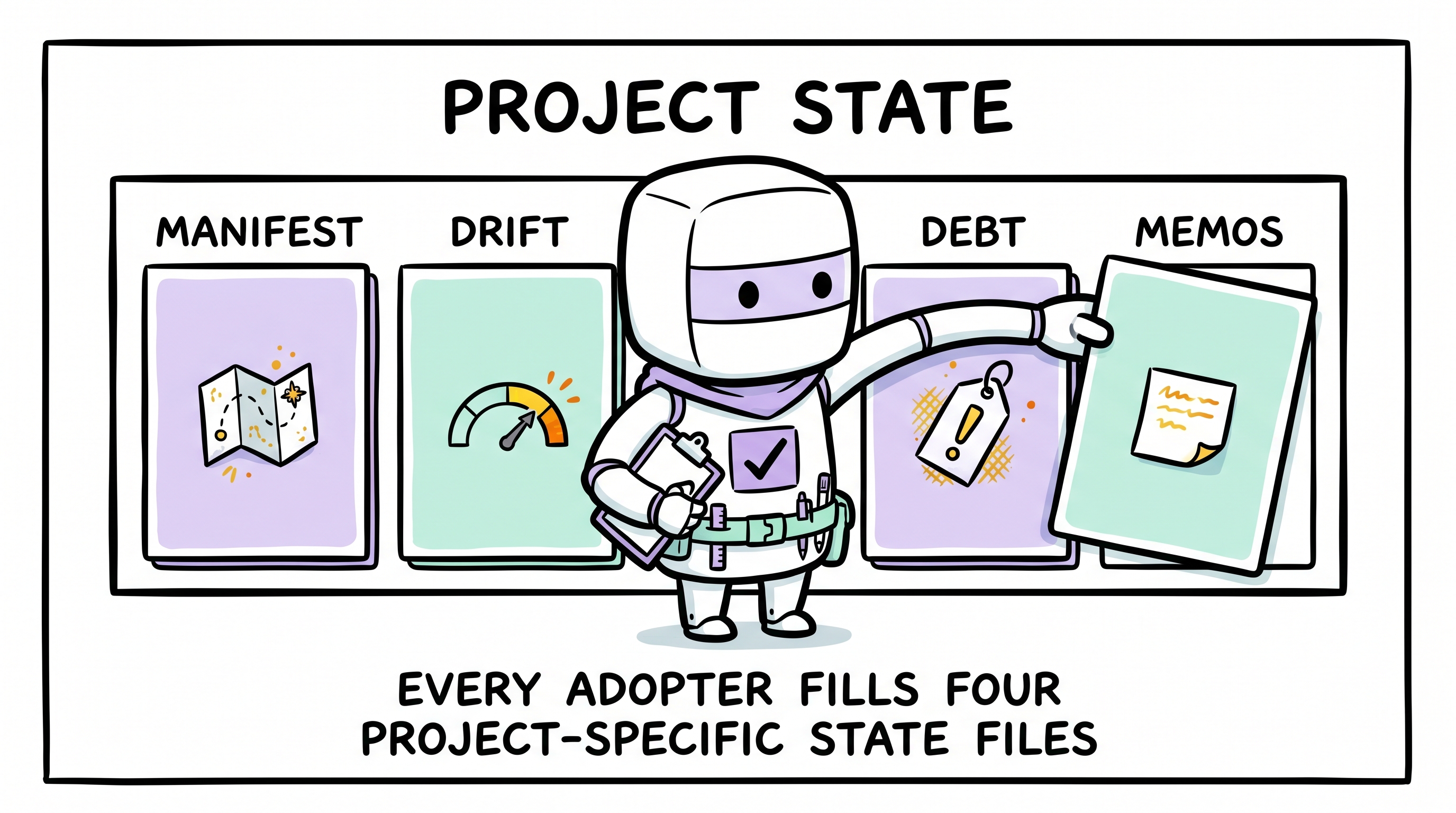
The following five files are project-specific. Initialize them by copying the authoring source's templates:
| File | Path | Template |
|---|---|---|
| Project hot context | .archon/manifest.md | docs/archon/templates/manifest.template.md |
| Drift counter | .archon/drift.md | docs/archon/templates/drift.template.md |
| Debt registry | .archon/debt.md | docs/archon/templates/debt.template.md |
| Stakeholder memos | .archon/memos.md | docs/archon/templates/memos.template.md |
| Project ADRs | .archon/decisions.md | docs/archon/templates/decisions.template.md |
Single source of truth: templates live only in
docs/archon/templates/. The export script reads those files directly, so the package you received already contains initialized copies at the target paths. Do not hand-copy skeletons from any other document —templates/*.template.mdare canonical.
Open each file, replace the <!-- ... --> placeholders with your project's values, and commit. manifest.md is the adopter's hot project map; these sections matter most:
- §Platform — map logical names (Rules Directory, Skills Directory, etc.) to actual paths for your AI platform
- §Product — one paragraph: what the product is, core flow, business model
- §Tech Stack — frameworks and versions you've chosen
- §Validation Command — the single
npm run validate/make validate/cargo test/ etc. entry point that runs lint + typecheck + test - §Context Budget — per-file line caps (recommended starting values are in the template)
- §Milestones & Acceptance Criteria — M0 acceptance items + quality gates
- §Current State — current milestone marker
manifest.md keeps current state, user-language aliases, and latest validation hot; move long latest-review detail to .archon/manifest/archive/<year>-Q<N>.md when needed. Per ADR-22 records-folder, memos.md is auto-generated from .archon/memos/records/ (most-recent 5 by date) — do not hand-edit; create a stakeholder-conclusion record file via node scripts/archon-records.mjs new memos --topic "..." --conclusion "..." --source ".archon/memos-archive/<year>-Q<N>.md ? keyword: ..." and put full rationale in the matching memos-archive/<year>-Q<N>.md. drift.md starts at 0 with the log table header ready. debt.md starts as a hot gate index with no active rows; put full rationale in debt/archive/<year>-Q<N>.md when registering detailed debts.
Operational contracts to preserve:
- The
manifest.mdLatest reviewhot row keepsLatest validation target:, the validation command, bundle evidence when available, and an archive pointer. Do not duplicate volatileN files / M testscounts there; keep detailed review history in.archon/manifest/archive/<year>-Q<N>.md. - Drift archives are cold delivery logs. Their
Rows archived:header must match the number of archived delivery rows in the table; the referencedrift-gatestest guards this. - Non-fast-path close-out rows include an Architecture Forecast (
risk|next|confidence). Treat it as a prediction for the next pre-scan, not as a backlog item or permission to skip the next Verdict.
Step 3: Structural Guards
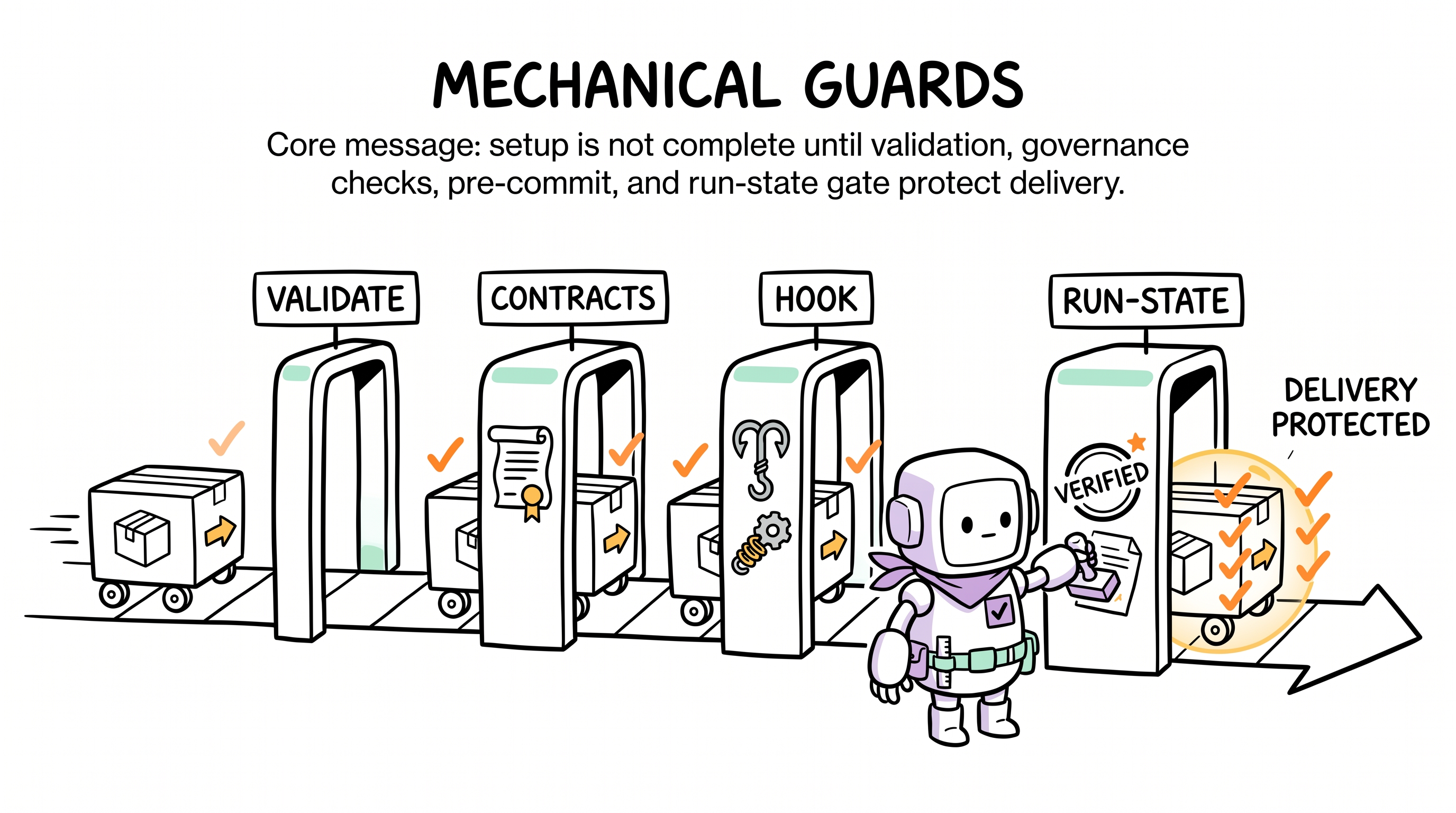
Archon's governance effectiveness depends on mechanical enforcement. The following three guard layers are ordered by enforcement strength (strongest first).
3a. Validation Command
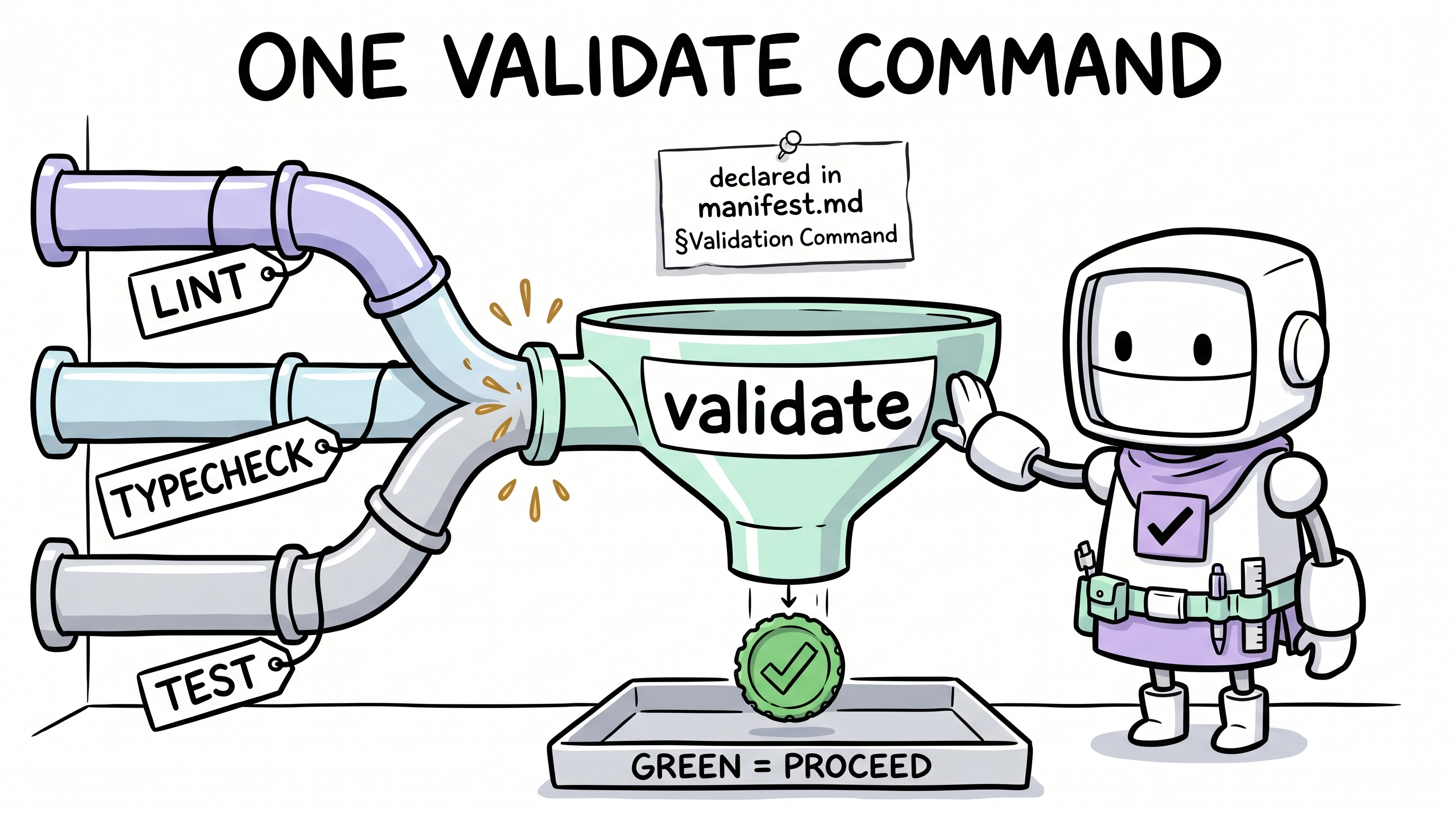
Register a single entry point validation command in your task runner, covering lint + typecheck + test. This is the sole channel for all quality checks.
Example (Node.js / package.json):
{
  "scripts": {
    "validate": "eslint . && tsc --noEmit && vitest run"
  }
}Declare this command in manifest.md §Validation Command.
3b. Governance Tests (Budget · Ratio · Drift Gate · Anchors · Rule Preservation · Convergence · Export)
All hot-path governance files MUST carry mechanical enforcement at the validation gate. Ten independent contract blocks cover the failure modes that documentation alone cannot prevent: bloat · tribal knowledge / bloat balance · drift accumulation · broken cross-references · silent prose drain · manifest↔command desync · export-package self-inconsistency · commit-gate bypass · said-vs-truth claim drift · preservation-axis degradation.
The portable baseline lives in .archon/contracts/governance-contract.yaml. The file is JSON-compatible YAML, so dependency-free runners can parse it with standard-library JSON support. TypeScript projects can keep a native test implementation, but the authoring source asserts its TS registry matches this contract; non-TS adopters can run:
python scripts/archon-check.py --root .
# or, on POSIX shells:
sh scripts/archon-check.sh .Block 1: File Budget (Prevents Bloat)
Governance files bloat with each delivery. When they exceed their cap, they erode the AI's context budget. Declare caps in the manifest's §Context Budget table; assert them as tests.
const FILE_BUDGET: Record<string, { limit: number; hint: string }> = {
  '.archon/soul.md':               { limit: 300, hint: 'Core soul — move mode-specific material to soul/<mode>.md' },
  '.archon/soul/delivery.md':      { limit: 150, hint: 'Delivery extension — move shared material back to core' },
  '.archon/soul/review.md':        { limit: 150, hint: 'Review extension — move shared material back to core' },
  '.archon/manifest.md':           { limit: 350, hint: 'Move long latest-review detail to .archon/manifest/archive/<year>-Q<N>.md' },
  '.archon/drift.md':              { limit:  70, hint: 'Move older complete rows to .archon/drift/archive/<year>-Q<N>.md' },
  '.archon/debt.md':               { limit:  40, hint: 'Keep hot gate index compact; move full rationale to .archon/debt/archive/<year>-Q<N>.md' },
  '.archon/memos.md':              { limit:  30, hint: 'Keep hot index compact; move full rationale to memos-archive/<year>-Q<N>.md' },
  '<decisions log>':               { limit: 300, hint: 'Archive superseded ADRs before any further cap raise' },
}
// For each file: read → count lines → expect ≤ limit with hint in error messageBlock 2: Governance Ratio (Prevents Both Bloat AND Tribal Knowledge)
Governance file count / source file count must stay within [0.1, 0.5]. Below 0.1 = tribal knowledge risk (implicit rules not written down); above 0.5 = governance bloat. Walk the governance directories and source directory, compute the ratio, assert both bounds.
Block 3: Drift Gate (Prevents Emergency-Level Drift Going Unreviewed)
Parse drift.md's current value and emergency threshold. If current ≥ emergency, the tail row MUST be a **Review reset** entry — otherwise the project is in a broken state (demands executed past the emergency ceiling without a review). The same guard should assert the progressive-loading contract: hot drift keeps an Archive Index and latest rows under budget, while .archon/drift/archive/*.md carries keyword-indexed cold logs. Without this test, documentation-only drift precheck was empirically bypassed (history: drift reached 108% of full threshold while demands kept executing).
Block 4: Soul Anchor Consistency (Prevents Broken Cross-References)
When soul.md is split into core + mode extensions (soul/delivery.md, soul/review.md), commands and agents reference specific headings via the soul[/delivery|review].md §X syntax declared in §Cross-Reference Convention. A refactor that renames a heading or moves content between files must update every reference — otherwise the agent follows a pointer to an anchor that no longer exists.
Scan every cross-reference source (commands, agents, soul extensions); for each soul[/delivery|review].md §X match, assert the target file exists and contains a heading matching §X. Also assert the extensions themselves exist and are loaded by the correct commands.
Block 5: Critical Rule Preservation (Prevents Silent Prose Drain)
Section-anchor checks (Block 4) guarantee the heading exists, but not that the substantive rule body below it remains intact. A future edit can silently drain a paragraph while the anchor survives — and no gate catches it. For any rule whose mechanical strength depends on the prose wording itself (not just the section's existence), register a substring assertion.
Maintain a registry of { file, substring, rationale } triples; for each entry, read the file and assert content.includes(substring).
Adopter projects start with an empty registry. The registry grows organically as your project's L3-originated prose rules get promoted to L2 — each promotion adds one row. When a rule eventually becomes a full mechanical check (e.g., a parser instead of a substring match), remove its registry entry.
Reference examples (from the Archon authoring source — illustrative, not prescriptive):
- Plan-mode binding paragraph in
archon-demand §Decision Gate— keywords:**Plan-mode binding**,BEFORE any write-side tool invocation - Convergence gate clause in
archon-demand §Decision Gate— keywords:**Convergence gate**,out of convergence scope - Two-hats extended clause in
soul §Quality Discipline— keyword:rename + a rule promotion on the same concept still counts as two hats - Glossary scope rule in
soul §Knowledge Hygiene— keyword:Glossary scope - Vocabulary-coherence question in
soul/review §Proactive Scrutiny— keyword:**Vocabulary coherence**
These come from specific deliveries in the Archon source repo's history. Do not copy them verbatim into a fresh adopter project — they will fail red because your soul files do not contain those phrases yet.
Block 6: Convergence Gate Contract (Prevents Manifest↔Command Desync)
Activation is conditional: this test is a no-op in the "open period" (no forced convergence active). It fires only when the project opts into milestone-level forced convergence.
If the manifest's §Current State declares a Convergence scope: [<DEBT-IDs>] field (forced-convergence active), the archon-demand command file MUST contain the **Convergence gate** clause and the out of convergence scope rejection phrase — otherwise the Verdict step has nothing to enforce the scope against. When Convergence scope is absent, the assertion returns early and imposes no constraint.
Keep this block in the test file even while inactive — it costs nothing and activates automatically the moment the manifest declares a scope.
Block 7: Export Manifest Contract (Prevents Distribution Self-Inconsistency)
When the project is the Archon authoring source (ships the scripts/export-archon-core.mjs equivalent), the export manifest must match this setup guide and the README's file tree. If setup.md or README describes a file that isn't exported, adopter projects receive silent gaps; if the export ships a file that no document mentions, adopter agents find stray files and don't know how to use them.
The test inspects the export script's file lists (core files + platform files + template files + doc files + skill files) and asserts bidirectional coverage with both this setup guide's Step 1 file tree and the README's Quick Overview.
Adopter projects that don't maintain their own export script can safely skip Block 7.
Block 8: Run-State Contract (Prevents Commit-Gate Bypass)
Run-State v2 (.archon/runs/<run_id>/state.json) is the machine-readable counterpart of the Verdict + Close-Out chat statements. It exists only while a delivery is in flight — activated after Verdict, updated per phase, removed by archon-git-commit after a successful commit. Legacy .archon/run.md remains as a migration fallback for adopter projects not yet shipping the helper. Four always-on contract checks ensure the plumbing stays honest even between deliveries:
.archon/templates/run-state.schema.jsonand legacyrun.template.mdexist and are shipped in the export.{platform}/skills/archon-git-commit/SKILL.mdexists and is registered in the export's platform files.- The pre-commit hook calls
scripts/archon-run-state.mjs resolve-for-commitand retains the legacypermit_commitfallback. archon-demand.mdcontains the "Run-State Lazy Activation" clause and documents both v2permitCommitand legacypermit_commit: 1.
A fifth check activates only when legacy .archon/run.md is present: YAML front matter declares demand · mode · started_at · plan_mode · convergence; a permit_commit: 0|1 line is present; status tokens use only 1 / 0 / 2 / skip:<reason>; line count ≤ 50. V2 active states are checked by scripts/archon-run-state.mjs check.
This block prevents five specific failure modes: forgetting to ship the schema/helper (adopters can't learn or operate the format), deleting the skill (commit gate loses its reader), breaking the hook (commit gate loses its enforcer), letting archon-demand.md silently drain its run-state instructions (agents stop initializing state), and reintroducing the single-file concurrency bottleneck as the default path.
Block 9: Claim Verifier (Prevents Said-vs-Truth Governance Drift)
Governance prose can quietly diverge from the repo: a test count cited from memory, a borrowed concept without lineage, a soul edit that cites itself as authority, a trigger claimed to have fired without evidence, or a Preservation checklist row padded with hand-wave evidence. Each failure mode had been tracked as its own debt (DEBT-058 numeric · DEBT-066 borrowed · DEBT-070 self-cite · DEBT-071 missed-trig · DEBT-074 preservation substance). Per ADR-27, one verifier unifies the family:
npm run archon:verify        # runs all modes
# or individually:
node scripts/archon-claim-verifier.mjs --mode=numeric
node scripts/archon-claim-verifier.mjs --mode=borrowed
node scripts/archon-claim-verifier.mjs --mode=self-cite
node scripts/archon-claim-verifier.mjs --mode=missed-trig
node scripts/archon-claim-verifier.mjs --mode=preservationAll modes share a single report prefix — [claim-verifier:<mode>] <FAIL|WARN>: <file> — <msg> — so a single grep surfaces every claim drift regardless of mode. The verifier is wired into npm run validate (errors fail closed, warnings surface) and .husky/pre-commit. The portable archon-check.py remains the adopter-side contract checker; the verifier is the per-delivery scan against git diff or .archon/*/records/ recent entries. Future family members enter as new modes rather than new scripts — when the script exceeds ~300 lines, modes are refactored into separate files behind an index, not split into parallel CLIs.
Preservation mode deserves a specific note (per ADR-28 hardening): it gates two distinct degenerate shapes of the Close-Out Preservation row. The none-this-cycle(<evidence>) escape valve requires evidence ≥40 characters AND a verb-of-scanning (e.g., scanned, reviewed, checked) AND a named scan target; hand-wave strings fail closed. The first-pass-degeneracy guard catches an introducing delivery that pins its own newly added anchors as pinned(...) — such a pin must be framed as first pass, introducing delivery, or pinned-bootstrap, otherwise the verifier rejects the self-promotion until at least one subsequent cycle lands.
Block 10: Preservation Axis Imperatives (Evolution's Second Motion)
Beyond the claim-verifier substance gate in Block 9, the Preservation motion introduced by ADR-28 carries three non-verifier contract points:
- Close-Out checklist row —
archon-demand.md §Close-Outcontains aPreservation pass:row that accepts onlypinned(<anchor>+<test>+<contract>)ornone-this-cycle(<evidence>). Absence of the row fails anchor-consistency (Block 4). - Capture-auditor §Preservation Scan — the auditor protocol must list 5 jobs and 7 steps (5 jobs + 2 setup), with contiguous numbering 1..N. An L1 step-count test catches "insert new step + forget to renumber" (e.g., two step "4"s).
- Header-anchor body-shape declaration — every header-shape entry in the critical-rule registry MUST declare
body_shape: 'has-body-shape-test' | 'header-only' | 'token-only'. Absent declaration fails L1 lint;has-body-shape-testentries must be paired with an actual body-shape assertion (same as Block 5, but with type-level enforcement added per ADR-28 hardening pass).
These three guards together make Preservation a mechanical triple (registry anchor + body-shape test + portable contract entry), not a prose reminder. See ADR-28 in the decisions log for rationale.
Delivery log + post-delivery review: every completed demand writes a drift log entry, then asks both: (a)(b)(c) whether the delivered work or the delivery process itself should improve (crystallization), AND (d) whether this delivery relied on a load-bearing anchor that should be pinned (preservation, per ADR-28). Keep this review lightweight: record one-off observations in the drift entry, and promote only repeated failures, auditor/reviewer findings, unstable manual steps, or mechanically enforceable constraints to debt/rule/test/skill/ADR. Each review labels the signal with evolution_triage=stats-pass|first-principles-pass|stay-in-drift: statistics filter routine noise only after 2-3 related samples, while first principles allow rare one-off signals only when they falsify a core assumption and name the smallest validation experiment. The label also carries matching compact evidence via evolution_evidence=stats(...), evolution_evidence=first-principles(...), or evolution_evidence=drift(...). The preservation answer is recorded as preservation: pinned(<anchor>+<test>+<contract>) | none-this-cycle(<evidence>). This keeps Archon learning and keeping after each delivery without turning Close-Out into a growing checklist.
Reference implementation: see .archon/contracts/governance-contract.yaml plus scripts/archon-check.py for a dependency-free baseline. The Archon authoring repo's governance.test.ts remains the TypeScript reference implementation and asserts its portable registry matches the YAML contract.
Note on subdirectory test runners: if your test framework runs in a subdirectory (e.g., web/), the test file's ROOT constant must resolve to the project root so it can read .archon/* at the real paths. A common pattern: const ROOT = resolve(process.cwd(), '..').
3c. Pre-commit Hook
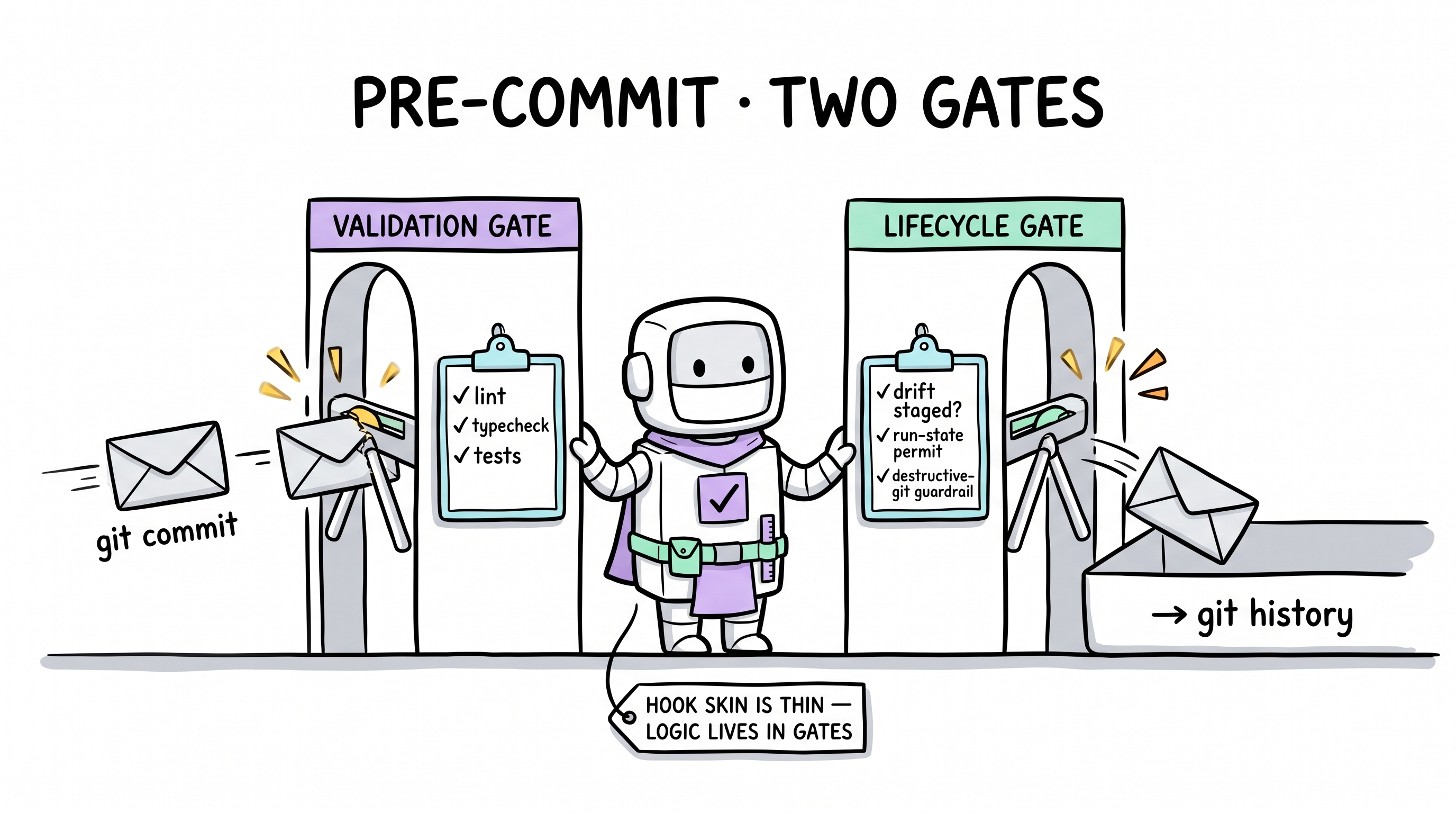
The git pre-commit hook does two things:
- Run the validation command (code quality + governance budget, all covered by tests)
- Lifecycle gate (check git staged state — this can only be done in a hook)
Reference implementation (Husky):
Install:
npm install -D husky
npx husky init.husky/pre-commit:
# Replace <source-dir> with your source directory and <validate-command> with the validation command from manifest.md
cd <source-dir>
<validate-command>

cd ..

# ── Archon Lifecycle Gate ──
# Source changes must be accompanied by drift log updates,
# ensuring the delivery close-out process is not skipped.
if git diff --cached --name-only | grep -q '^<source-dir>/'; then
  if ! git diff --cached --name-only | grep -q '^.archon/drift\.md$'; then
    echo ""
    echo "⛔ Archon lifecycle gate: source changed but drift.md not staged."
    echo ""
    echo "   Complete delivery closing steps before committing:"
    echo "   1. Sync manifest   2. Run Blink Dispatch/subagent steps   3. Update drift log"
    echo ""
    exit 1
  fi
fi

# ── Archon Run-State Gate (ADR-14 / v2) ──
# Active v2 delivery must resolve to exactly one permitCommit=true run.
node scripts/archon-run-state.mjs resolve-for-commit

# Legacy fallback: run.md present must have permit_commit: 1 — otherwise the
# Verdict · execute · validate · close-out SOP has pending steps.
if [ -f .archon/run.md ]; then
  if ! grep -qE '^permit_commit:[[:space:]]*1[[:space:]]*$' .archon/run.md; then
    echo ""
    echo "⛔ Archon run-state gate: active delivery has pending SOP steps."
    echo ""
    echo "   Pending (first 5 rows with status=0):"
    grep -E '\|[[:space:]]*0[[:space:]]*\|' .archon/run.md | head -5 | sed 's/^/     /'
    echo ""
    echo "   Complete the remaining steps per archon-demand.md § Close-Out,"
    echo "   or 'rm .archon/run.md' to abandon this delivery."
    echo ""
    exit 1
  fi
fiSeparation of concerns: Testable constraints go in tests (governance budget, code standards); git-state-dependent checks go in hooks (staged file checks). Keep hooks thin.
3d. Run-State Files (ADR-14 / v2)
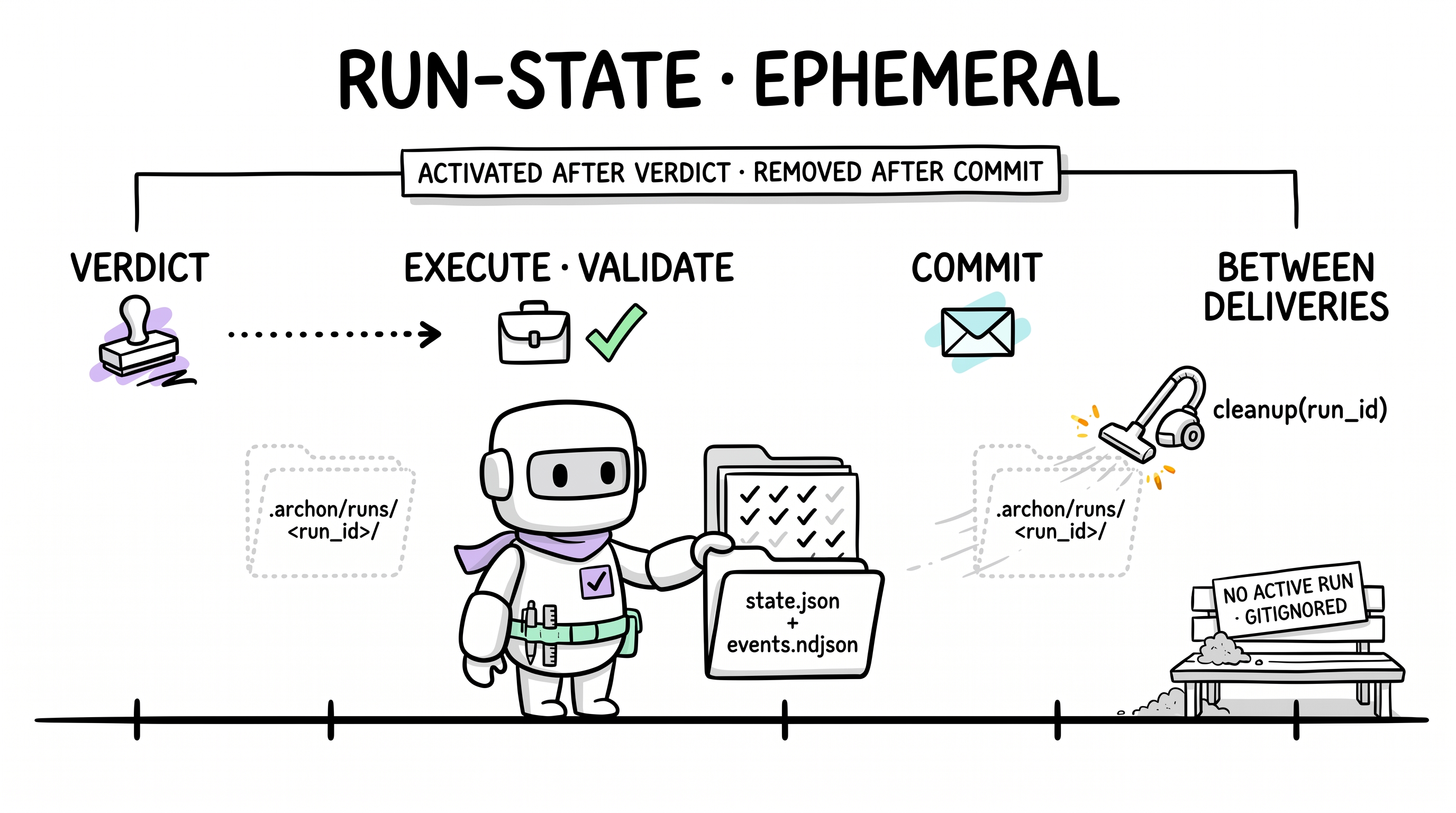
Run-State v2 stores one delivery per directory: .archon/runs/<run_id>/state.json plus optional events.ndjson. It is ephemeral — activated after Verdict, updated as each SOP phase completes, and removed by the archon-git-commit skill after a successful commit. Between deliveries there are no active run directories.
Must be gitignored. Add .archon/runs/ and legacy .archon/run.md to your repo's .gitignore before adopting the commit gate. These files carry in-flight state that must never enter history: committing them would cause ping-pong diffs and leak per-session context into the log.
Concurrency model: v2 removes the singleton bottleneck. Each delivery has a distinct run_id, and commit-time resolution fails closed if multiple commit-ready runs exist unless ARCHON_RUN_ID is explicit. The resolver also rejects staged files that are not listed in the selected run's changedPaths, preventing a second session's files from being swept into the wrong commit. Git worktrees remain the recommended way to do truly concurrent editing because overlapping edits to the same file are still a source-control problem, not a run-state problem. Legacy .archon/run.md keeps the old demand-mismatch fallback only for migration.
Schema (see .archon/templates/run-state.schema.json):
{
  "schemaVersion": 2,
  "runId": "20260425-abc123",
  "demand": "...",
  "status": { "validate.validation_green": "1" },
  "changedPaths": ["..."],
  "permitCommit": true
}Status values remain unchanged: 1 (completed), 0 (pending/in-progress), 2 (user-intent smart-skip, ADR-15 — only on permission-list rows, requires drift rationale), skip:<reason> (mode-driven bypass). permitCommit: true is the final gate and is set only after every required status is complete.
2 vs skip:* — audit strength differs. skip:* carries its reason in the token itself (structural / mode-driven) and passes a static check. 2 means a human chose to bypass; the reason lives externally in drift.md as smart-skip: <phase>.<variable> — <reason>, which governance.test.ts Block 8 cross-references. Use 2 ONLY when the user explicitly asked (imperative, affirmative reply to agent proposal, or demand-level [trivial] / [quick patch] / [docs-only] hint). An agent's own judgment that a step is unneeded is a mode-class skip (skip:no-change / skip:no-decision-value / skip:no-extensions) — don't smuggle it into 2. The permission list (six rows: prescan.archive_scanned, all five non-terminal closeout.* audit rows) is hard — soul-enforced rows (validate / drift_updated / statement_output / etc.) never accept 2.
Mode-specific forms:
- Standard (default): ~21 rows spanning boot · prescan · decision · execute · validate · closeout.
- Fast-path: the four rows
decision.verdict_output·execute.changes_applied·validate.validation_green·closeout.drift_updated(+closeout.manifest_synced·closeout.statement_output) stay at1; everything else isskip:fast-path. - Rejected (
Verdict=reject):decision.verdict_output+closeout.drift_updated+closeout.statement_outputstay at1; execute / validate and most closeout rows becomeskip:rejected.
Why a separate runtime directory (vs. inlining into drift.md or memos.md): drift.md is append-only historical log — mid-flight state would pollute it. Close-Out statements live in the chat and disappear after compact. .archon/runs/<run_id>/state.json is the mechanical ledger of in-flight progress, and the only artifact a pre-commit hook should consult before letting a commit through.
3e. Destructive-Git Guardrails (B4 L1 Interception)
Soul §Constraints carries a "no destructive git without drift rationale" rule. As long as it lived only in prose, both humans and agents could violate it silently with a single git push --force or git reset --hard. B4 promotes this rule from L3 to L1 via two independent mechanical interceptors that together cover every client path:
.husky/pre-pushhook — client-agnostic, fires on any push that reaches git (CLI, VS Code, JetBrains, Cursor, GUI clients). Blocks--force/--force-with-leaseand non-fast-forward pushes. Because it runs inside git itself, it cannot be bypassed by choosing a different terminal or editor.- Cursor
beforeShellExecutionhook (.cursor/hooks/archon-destructive-guard.mjs) — agent-shell guard fired before the agent executes any shell command. Interceptsgit reset --hard,git branch -D,git clean -f*, andgit checkout -Bbefore they touch the working tree. Fail-closed on parse failure — an unparseable command is rejected, never silently allowed.
Bypass is explicit: ARCHON_ALLOW_DESTRUCTIVE=1 <command> lets a single call through, but the next Close-Out MUST record a drift row naming the command and the rationale. Missing rationale triggers the claim-verifier missed-trig mode on the next delivery.
Cross-platform note: .gitattributes pins LF on *.sh and .husky/* to prevent Windows core.autocrlf from corrupting hook shebangs. The Cursor hook is implemented in Node (*.mjs) specifically because Cursor on Windows resolves /bin/sh to WSL, which breaks POSIX shell hooks — Node runs identically on all three platforms.
Governance anchoring: 3 portable-contract entries (governance-contract.yaml) + 3 critical-rule substrings (Block 5 registry) + export-manifest inclusion of the guard script and hook config. Removing any one anchor without the paired edits fails Block 4 (anchor consistency) or Block 7 (export manifest).
Adopter projects without Cursor can ship just the pre-push hook and skip the .cursor/hooks/ half. Adopter projects that want to permit destructive ops as a matter of course can remove the pre-push hook entirely — but then soul §Constraints must also drop the no-destructive-git rule so prose and mechanism stay aligned.
Step 4: Optional Enhancements
Add these as needed — not required for initial setup, but each closes a specific governance gap as the project grows.
Lint-Rule Bridge
Have linter error messages point to rule files in the platform rules directory, forming an L1→L2 active trigger loop.
Convention: Custom lint rule error message format = self-contained fix guidance + → Read <rule-file-path>.
Example (ESLint no-restricted-imports, Cursor platform):
{
  message: 'Pages import from @/lib/api directly. Use hooks instead. → Read .cursor/rules/frontend.mdc',
}Project Rules (Rules Directory)
Coding standards, architecture boundaries, design system specs, and other project-specific editor rules. For each rule, ask "who ensures it's followed?" — if the answer is "whoever reads it," consider pushing to a lint rule.
Skill Documents (Skills Directory)
Reusable domain knowledge: design system, API specs, framework best practices, component guides, etc. Maintain an index in manifest.md §Knowledge Assets. The pre-installed archon-framework skill serves as a working example and stays in place permanently.
Architecture Decision Records
.archon/decisions.md — project-specific ADRs for the adopter project. Each entry records date, status, decision, rationale, impact, and re-evaluation triggers. docs/archon/decisions.md is separate: it explains Archon framework decisions that ship with the reusable kit.
Extensions (.archon/extensions/)
Extensions are project-specific capabilities that hook into Archon's fixed lifecycle points without modifying core files. They implement the plug-in pattern: install = create a directory with extension.md; uninstall = delete the directory.
Lifecycle points that extensions can hook into (declared in soul.md §Extension Points):
| Point | Command | When |
|---|---|---|
demand.pre-scan | archon-demand | After loading memos, before decision gate |
demand.close-out | archon-demand | After stakeholder memos, before git |
plan.perception | archon-plan | During state perception phase |
plan.output | archon-plan | After priority ranking, before final output |
review.health | archon-review | During knowledge health audit |
Budget rules: max 3 active extensions per project, ≤ 15 lines per hook declaration. Extensions are NOT exported with the core kit — they are always project-local. See soul.md §Extension Points for the complete discovery protocol and extension.md file format.
Dashboard (.archon/dashboard/)
A zero-dependency Node.js dashboard that visualizes governance state (milestones, drift log, debt registry, ADR timeline, delivery cadence) by parsing .archon/*.md directly.
- Install: the dashboard is optional and not exported by default. Copy
.archon/dashboard/from the authoring source when you want governance visualization. - Launch: run
/archon-dashboardornode .archon/dashboard/server.js. - Deactivate: delete
.archon/dashboard/. Thearchon-dashboardcommand will no-op until the directory returns. - Optional heartbeat rule (
{platform}/rules/archon-heartbeat.mdc): provides more precise session state inference by writing transient heartbeat files during delivery. Entirely optional — the dashboard falls back to passive inference from transcripts when heartbeats are absent.
Step 5: Verify Installation
Run /archon plan (or /archon-plan). Archon will hot-path read the required soul.md, soul/review.md, manifest.md, and drift.md sections, then output next-step recommendations based on project state. If it produces a coherent summary and plan, the framework is loaded successfully.
Additionally, the agent should consult the archon-framework skill on its first Archon-related action in the session — archon-wake.mdc will guide it there. If you ever want to test the primer flow manually, ask the agent "what is Archon and how does this project use it?" — it should cite {platform}/skills/archon-framework/SKILL.md.
Checklist
| Step | Artifact | Verification |
|---|---|---|
| Copy framework files | .archon/soul.md + .archon/soul/{delivery,review}.md + {platform}/{commands,agents,rules,skills}/archon* | All files exist; archon-wake.mdc and archon.mdc present in rules; archon-framework/SKILL.md + archon-git-commit/SKILL.md + blink-dispatch/SKILL.md present in skills |
| Create manifest | .archon/manifest.md | Platform mapping + all <!-- --> placeholders filled; §Context Budget, §Validation Command, §Milestones present |
| Create drift | .archon/drift.md | drift: 0, log table header ready |
| Create debt | .archon/debt.md | Template copied, Archive Index + Active Debt Index sections ready |
| Create memos | .archon/memos.md | Template copied, Archive Index + Hot Memos sections ready |
| Run-state schema/helper | .archon/templates/run-state.schema.json + scripts/archon-run-state.mjs | Files present; .archon/runs/ and legacy .archon/run.md are gitignored and NOT created here — they appear only during active deliveries |
| Register validation command | package.json / Makefile / etc. | Command runs and passes green |
| Governance tests (6-8 blocks) | Test file | Validation runs: budget (≥7 files) + ratio [0.1, 0.5] + drift gate + manifest/memos/debt hot-index/archive contracts + soul anchors + critical-rule substrings (registry may start empty) + convergence-gate contract (may be no-op) + export-manifest contract (authoring source only) + run-state contract (template + skill + hook + demand-cmd clauses) |
| Pre-commit hook | .husky/pre-commit or equivalent | git commit triggers validation + lifecycle gate + run-state gate (when .archon/run.md is present) |
| First plan | /archon plan or /archon-plan output | Archon correctly loads the required soul/manifest sections; archon-framework skill consulted on first archon-related action |