
From Refactoring to Archon — Translation Path and Engineering Landings
An evaluation of Martin Fowler's Refactoring: Improving the Design of Existing Code (2nd ed., 2018) against the Archon framework, extracting actionable engineering disciplines.
Authority note: this document records the full translation process (Why + How). The operative definitions of each discipline live in
soul.md— if this document conflicts with soul, soul wins.
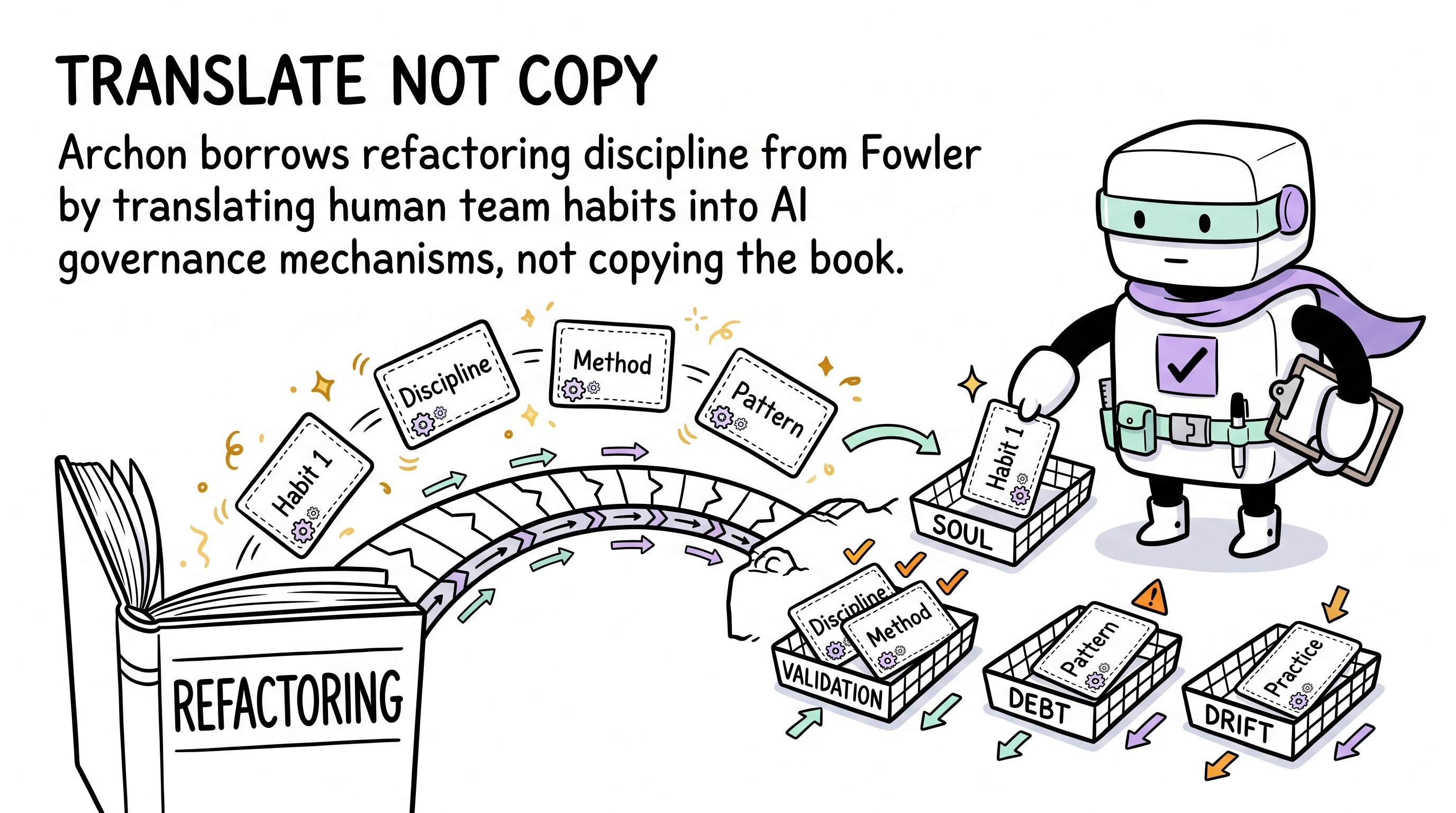
1. Why examine this book
Refactoring solves a core problem: how to continuously improve internal structure without changing external behavior. This matters just as much for AI engineering governance — but it can't be copy-pasted. Fowler's context is human teams collaborating; Archon's context is session-based AI-agent autonomy. What follows is a translation path, not a textbook port.
2. Concept cheat sheet
| Concept | One-line summary |
|---|---|
| Refactoring | Improve internal structure in small steps without changing external behavior |
| Code Smells | Surface symptoms hinting at deeper structural problems (22+ categories) |
| Two Hats | At any moment do one thing: add features or refactor, never both |
| Rule of Three | First time write it; second time tolerate it; third time abstract |
| Characterization Test | Before refactoring, write tests to pin current behavior first, then touch structure |
| Branch by Abstraction | Large-scale replacement without halting — old and new coexist, migrate gradually, delete old at the end |
| Refactoring Catalog | Each smell pairs with a set of named techniques, forming a reusable diagnostic lookup table |
3. Relationship to Archon
3.1 Already aligned (no new action needed)
Several of Archon soul.md's principles naturally coincide with Fowler's, just expressed in different vocabulary:
| Fowler | Archon | Assessment |
|---|---|---|
| Eliminate dead code | Zero-tolerance for dead code | Fully aligned |
| Single Responsibility / Extract Class | One file, one job; split when it bloats | Aligned |
| DRY / Eliminate duplication | Pattern consistency — one way to do one thing | Aligned |
| Tests as safety net | Validate gate (validate fully green) | Aligned |
| Continuous improvement over big rewrites | Drift small-step accumulation + evolution mechanism | Aligned |
| Avoid speculative abstraction | Leanness > accumulation | Aligned |
| Naming is design | Naming is design | Fully aligned |
These aren't coincidences. Fowler distilled from human team collaboration; Archon derived from AI-agent autonomous governance. Both arrived at the same engineering bedrock.
3.2 Gaps (adopted and landed)
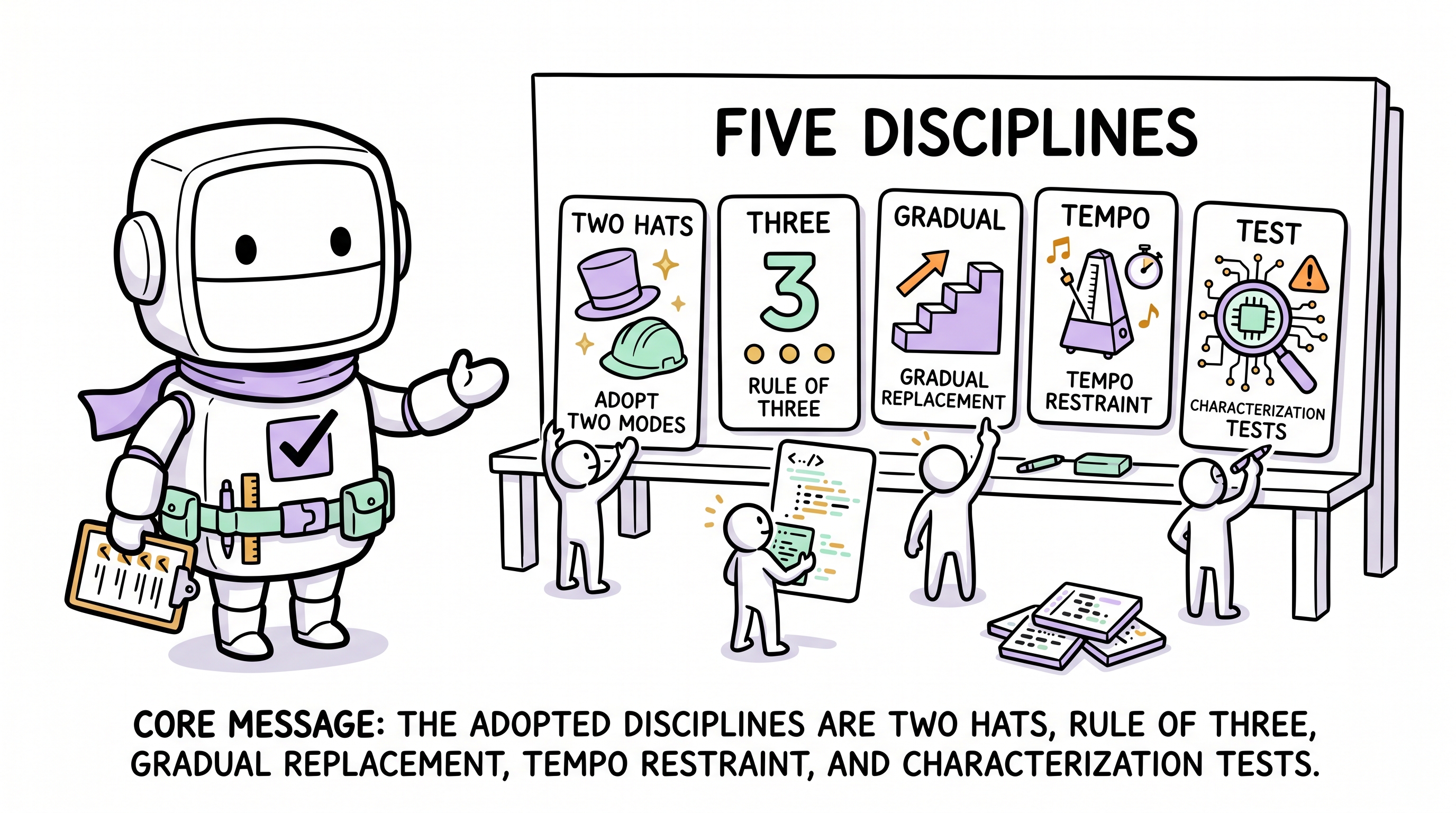
The following five items were present in Fowler and missing in Archon. All five are now written into soul/delivery.md:
| # | Gap | Fowler's original | Archon adaptation | Landing location |
|---|---|---|---|---|
| 1 | Two Hats | Don't mix features and refactoring | Ship the feature delivery first, then do a refactor delivery — separate commits | soul/delivery.md §Product Quality |
| 2 | Rule of Three | Abstract only on the third repetition | Avoid premature generalization; two repetitions isn't an abstraction trigger | soul/delivery.md §Product Quality |
| 3 | Gradual Replacement | Branch by Abstraction | Old and new coexist; migrate stepwise; no stop-the-world rewrite | soul/delivery.md §Product Quality |
| 4 | Restrained Tempo | Don't refactor near a deadline | If a milestone feature isn't done, log the smell as debt; don't fix on the spot | soul/delivery.md §Product Quality |
| 5 | Characterization Test | Write Characterization Tests before refactoring | Before refactoring an existing module, add tests that pin current behavior | soul/delivery.md §New Code = New Guardrails |
3.3 Explicitly rejected
| Candidate | Rejection reason | Archon principle cited |
|---|---|---|
| TDD mandate | Fowler recommends test-first, but the Archon agent chooses the optimal execution path itself. A mandate reduces flexibility; the validate gate already guards the quality floor | Ownership (agent judges its own path) |
| Standalone Refactoring Catalog doc | The 22 generic smell categories are textbook content, not project knowledge. Consult the book when needed; not worth maintaining a copy | Leanness > accumulation |
| Dedicated refactoring skill file | Currently no accumulated project-specific smell patterns. An empty-shell skill violates "create-to-defend" | Knowledge hygiene |
| Refactoring plan document template | Producing a plan file per refactor = governance bloat. Two-Hats discipline + validate gate are sufficient | Leanness > accumulation |
4. Adaptation approach: human discipline → AI mechanism
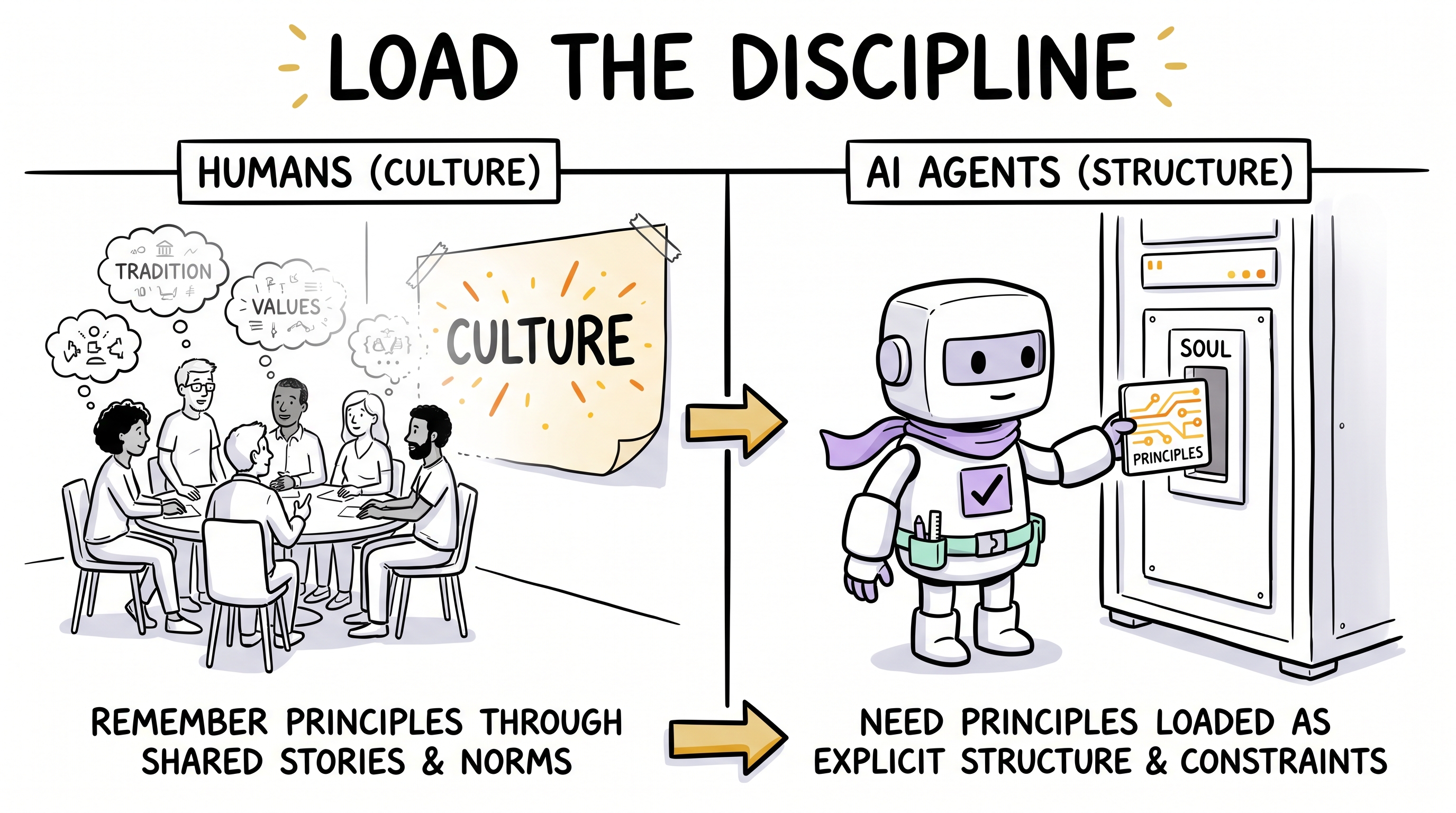
Fowler's refactoring disciplines rely on self-discipline, code review, and team culture. Archon's risk profile is different: an AI agent doesn't "forget the rules" the way a human would, but it does lose context and suffer cross-session cognitive drift. The adaptation goal is therefore to translate human behavioral discipline into AI structural constraint:
| Human (Fowler) | AI (Archon) | Translation |
|---|---|---|
| "Remember not to mix feature and refactor" | Two Hats written into soul/delivery.md → loaded automatically on every delivery | Behavioral discipline → cognitive pre-load |
| "Code Review catches smells" | Reasoning capsules embedded in skills → symptom maps directly to fix | Team review → self-evolving knowledge |
| "Refactor on the third repetition" | Rule of Three written into soul/delivery.md → decision anchor | Rule of thumb → decision primitive |
| "Write tests before refactoring" | Characterization tests written into New Code = New Guardrails → wired to the validate gate | Best practice → structural guard |
| "Phase large refactors" | Gradual Replacement written into soul/delivery.md → aligned with drift small-step accumulation | Project-management trick → engineering principle |
Key insight: humans need to remember principles; AI needs principles loaded. Archon's soul (core + pattern-loaded extensions) is read on demand at every boot; writing into soul equals writing into the agent's working memory.
5. The role of Code Smells in AI coding
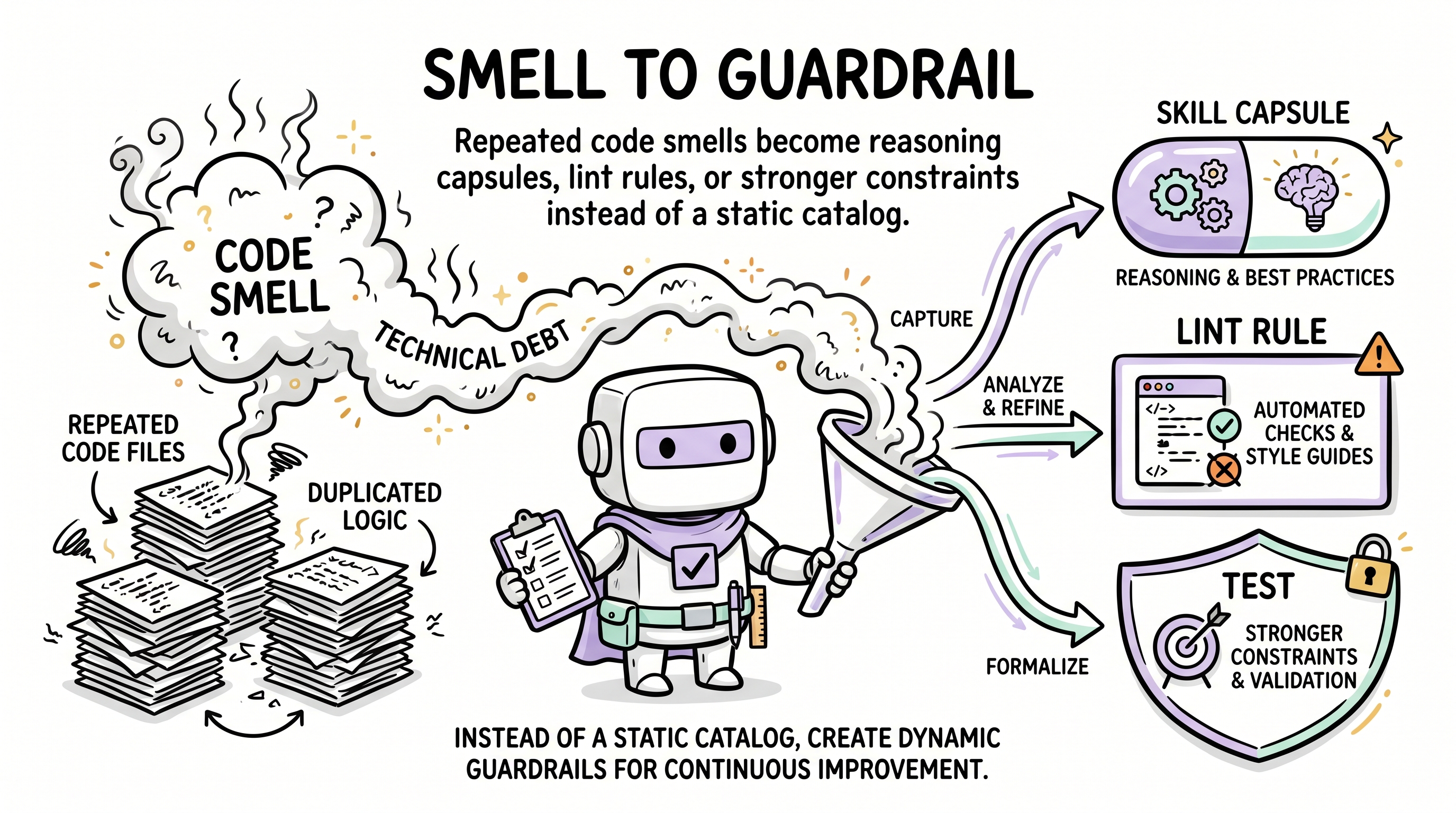
Fowler's 22 Code Smells are a diagnostic checklist for humans. For AI agents, the value isn't in "memorizing" them but in establishing smell → refactoring fast-decision paths.
Archon's handling strategy:
- Don't pre-store the generic catalog — the 22 smells are book knowledge the AI already has
- Accumulate project-specific mappings — when the same smell appears for a second time in this project, embed it in the relevant skill as a reasoning capsule (symptom → root cause → fix)
- From diagnosis to automation — if a smell can be detected by a lint rule, promote it to L1 (move up the Constraint Pyramid); more reliable than documentation
This matches soul's crystallization-path priority: if a lint can catch it, don't write prose; if a reasoning capsule can capture it, don't create a dedicated file.
6. Full quality-hygiene landscape after adoption
| Principle | Source | Enforcement |
|---|---|---|
| Naming is design | Original | Cognitive pre-load |
| Single Responsibility | Original / Fowler-aligned | Cognitive pre-load |
| Zero-tolerance for dead code | Original / Fowler-aligned | Cognitive pre-load |
| Types are documentation | Original | L0 compile constraint |
| Pattern consistency | Original / Fowler-aligned | Cognitive pre-load |
| Architectural boundaries | Original | L1 lint constraint |
| No TODOs | Original | Cognitive pre-load |
| Two Hats | Adopted from Fowler | Cognitive pre-load + commit-auditable |
| Rule of Three | Adopted from Fowler | Cognitive pre-load (decision anchor) |
| Gradual Replacement | Adopted from Fowler | Cognitive pre-load + drift-linked |
| Restrained Tempo | Adopted from Fowler | Cognitive pre-load + debt-linked |
| Characterization Test (new guardrails) | Adopted from Fowler | L2 test constraint |
7. Future evolution vectors
These aren't landed today, but may trigger evolution later:
| Trigger signal | Action |
|---|---|
| The same smell appears in the project for the 3rd time | Write a reasoning capsule and embed in the relevant skill |
| A smell becomes detectable by static analysis | Write a custom lint rule; promote the constraint from L3 to L1 |
| Milestone migrates critical infrastructure | Execute via Gradual Replacement (Branch by Abstraction) |
| Page-layer refactor (currently lacks tests) | Add Characterization Tests first, then touch structure |