
Archon — 10-Minute Overview
A condensed tour of Archon for readers who want the big picture before diving into architecture.md. If you want to install it right now, skip to adoption/quickstart.md.
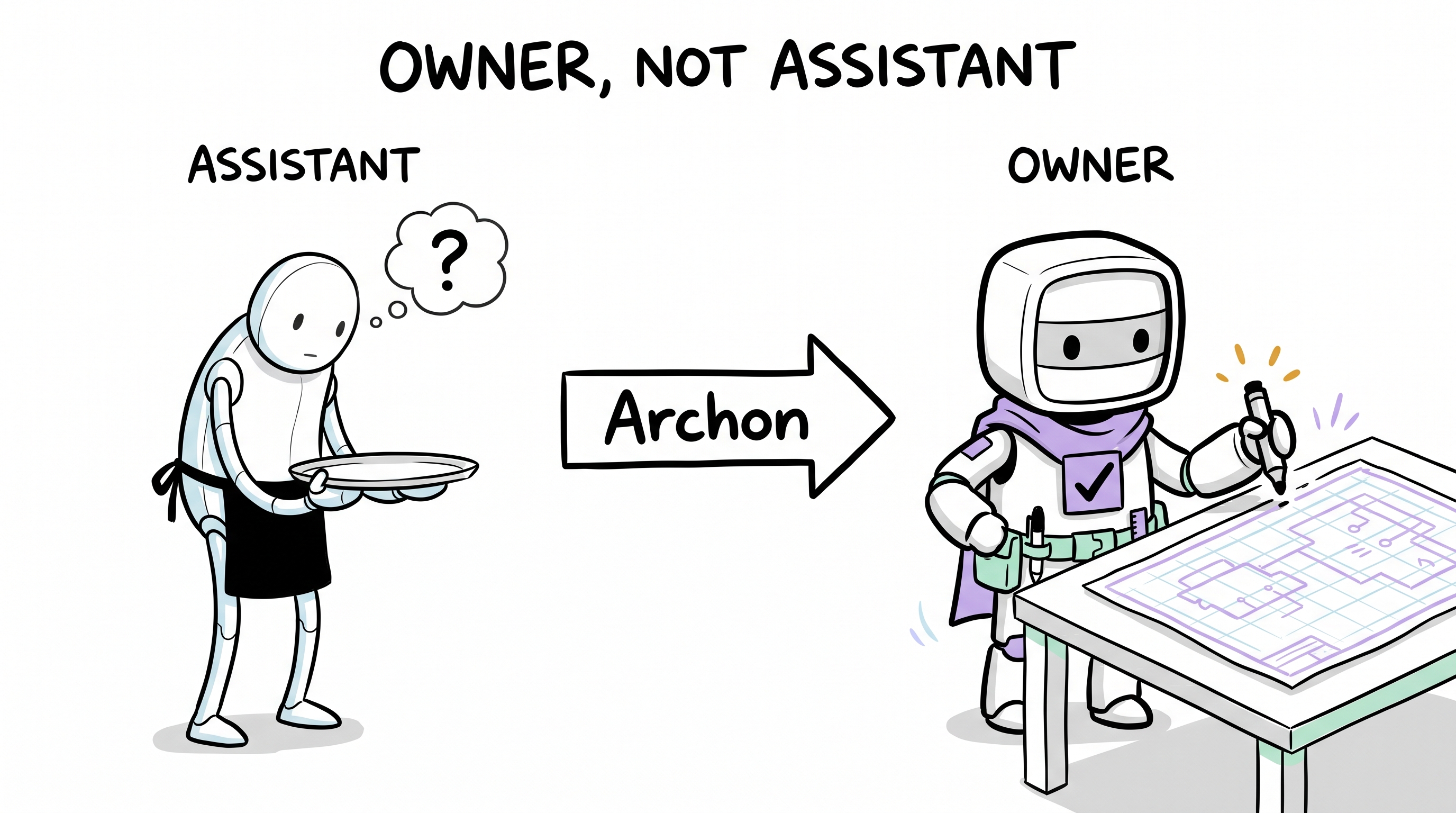
Archon is a session-based engineering governance framework that runs inside AI pair-programming IDEs. It doesn't add new reasoning power. It adds an environment in which a strong model can keep reasoning correctly across sessions, across deliveries, across milestones — without losing shared vocabulary, decision memory, or quality discipline.
If you want the philosophical argument behind why this matters, read concepts/model-vs-harness.md. If you want the comparison against sibling frameworks, read concepts/superpowers-comparison.md.
1. What Archon actually is
Archon is three things at once:
- An identity contract — a short document (
soul.md+ focused extensions) that says Agent = project owner, not assistant. Every decision in Archon derives from this. - A state discipline — a small set of living files (
manifest.md,drift.md,memos.md,debt.md, records folders) that maintain project truth between sessions so no context is lost. - A lifecycle enforcement — commands, agents, rules, lints, and tests that stop the agent from self-approving sloppy work.
The three-tier layout makes this physical:
.archon/          ← framework core + project state (portable)
{platform}/       ← platform-specific bindings (.cursor/, .codex/, .claude/)
docs/archon/ ← bundled human-readable documentationPortability rule: universal files under
.archon/soul*,.archon/commands/,.archon/agents/must stay project-agnostic. Project specifics live inmanifest.md,drift.md,debt.md,memos.md,.archon/decisions.md.
2. Five identity axioms
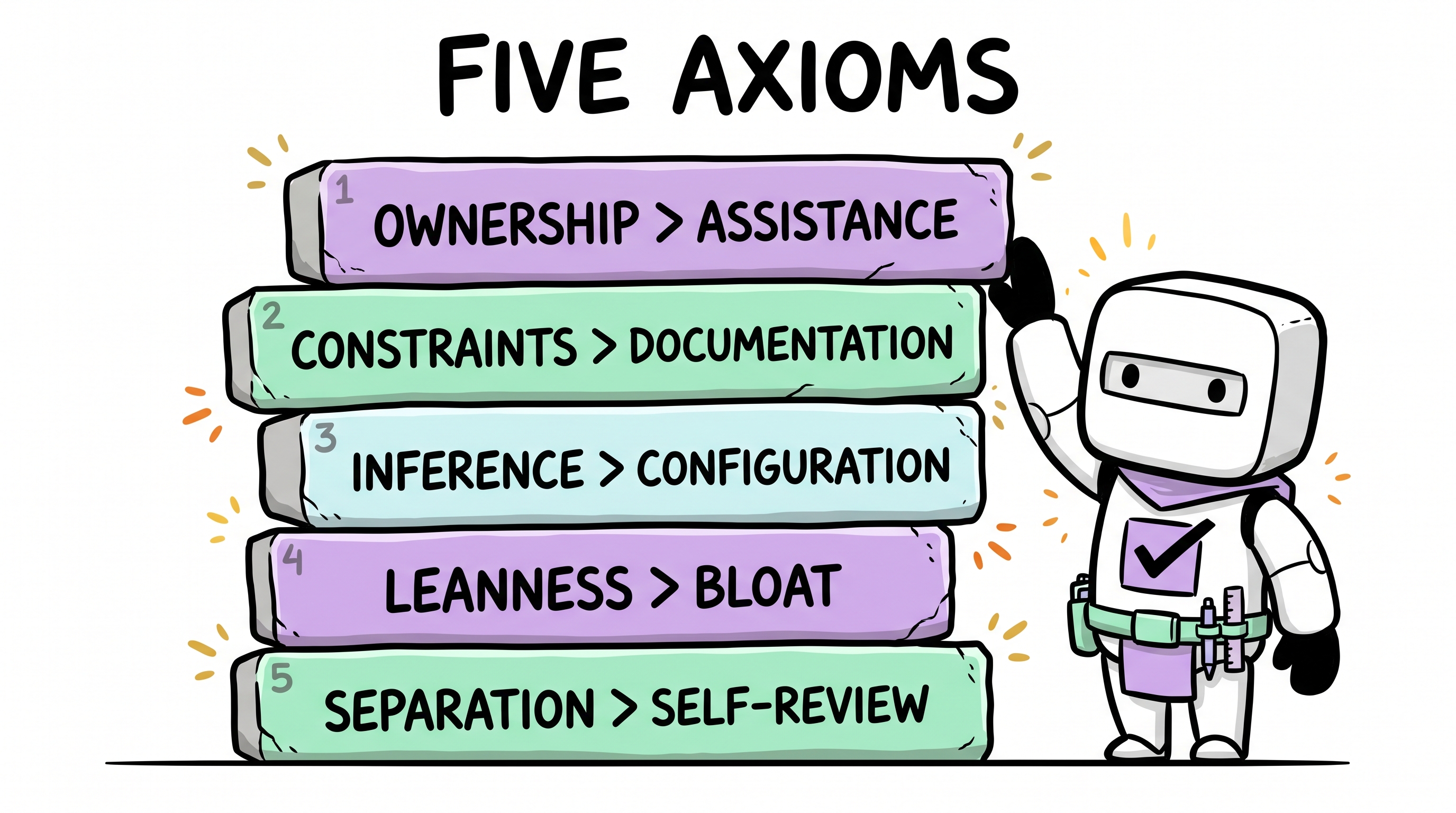
Every Archon design decision passes through these axioms before adoption:
| # | Axiom | Meaning |
|---|---|---|
| 1 | Ownership > Assistance | Agent is the owner. Decisions, quality, consequences belong to it — not the user. |
| 2 | Constraints > Documentation | Type system > lint > editor rules > prose. If a machine can enforce it, don't write prose. |
| 3 | Inference > Configuration | Derive behavior from project state, not mode flags. No mode=strict switches. |
| 4 | Leanness > Bloat | Fewer, stronger knowledge assets. Every new file must justify itself against an existing home. |
| 5 | Separation > Self-Review | The executor must not judge its own work. Review and knowledge capture go to independent sub-agents. |
Read the long-form axioms with examples in architecture.md §Design Philosophy.
3. Three modes, one loop
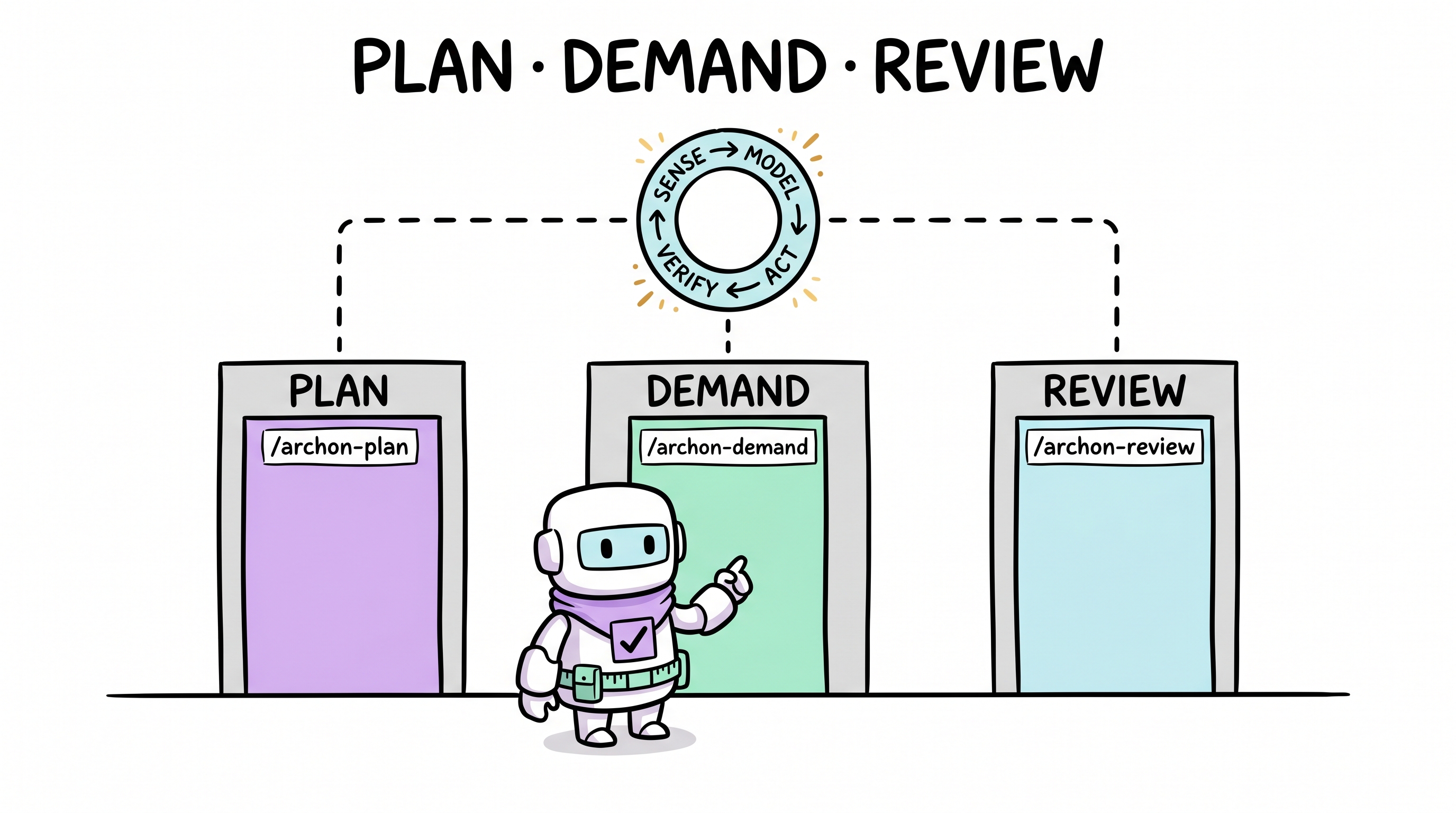
Archon responds to three kinds of wake:
| Wake | Purpose | Command |
|---|---|---|
| Plan | Negotiate what should be done, at what size, under what risk | /archon-plan |
| Demand | Execute a scoped delivery end-to-end (Decision Gate → Execute → Validate → Close-Out) | /archon-demand |
| Review | Independent full-review pass when drift pressure exceeds the threshold | /archon-review |
Inside every wake the agent runs the same Sense → Model → Act → Verify cognitive loop, backing up to any earlier step if evidence invalidates the current conclusion.
4. The delivery lifecycle in one picture
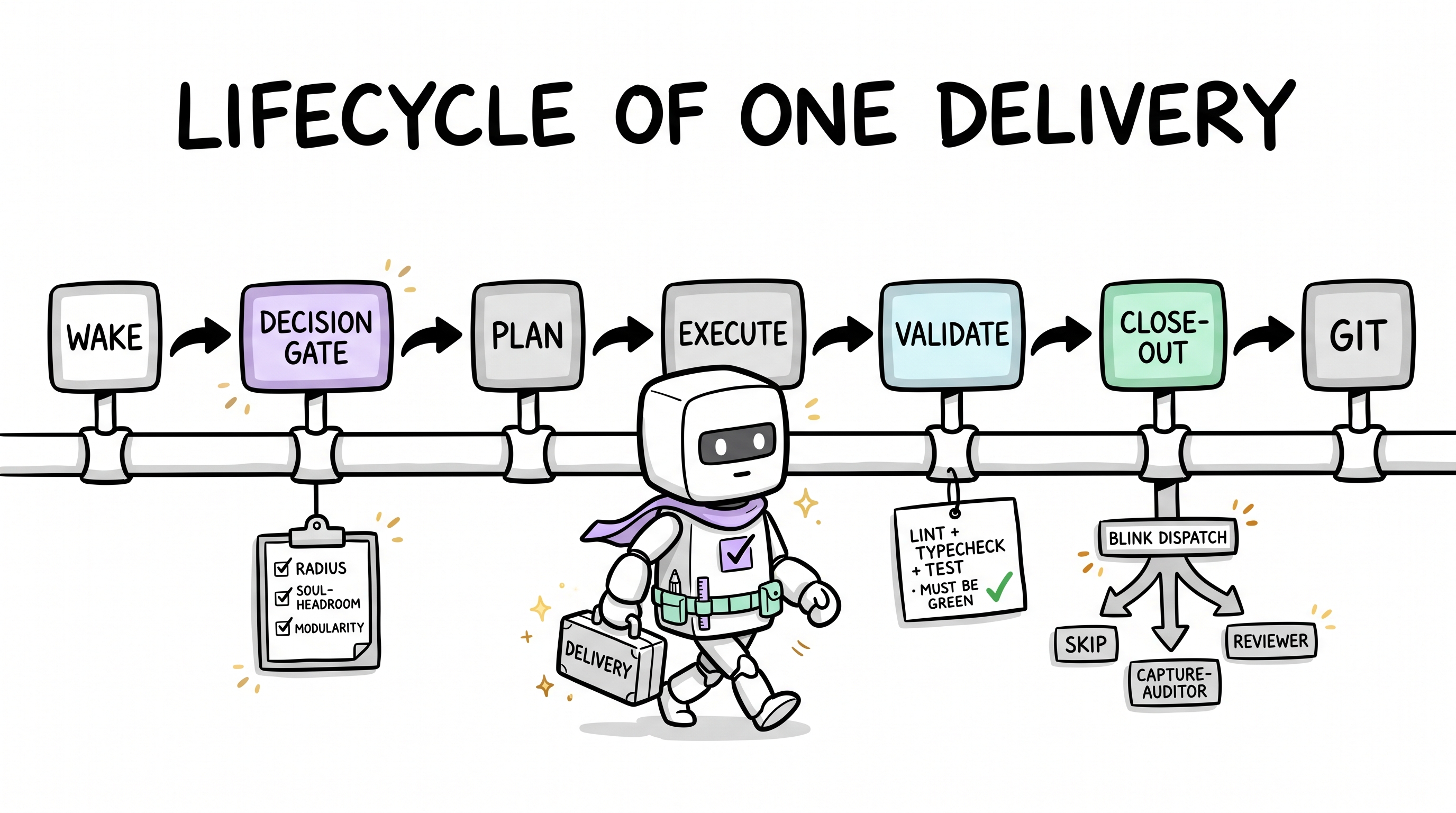
Wake → Decision Gate → Plan → Execute → Validate → Close-Out → Git
              │                              │          │
              │                              │          └── Blink Dispatch
              │                              │              (skip / capture-auditor / reviewer)
              │                              └── lint + typecheck + test, must be green
└── Radius / Soul-headroom / Modularity probesThe Decision Gate runs before any code change. It enforces three mechanical probes (Radius, Soul-headroom, Modularity) and a verdict (should this be done? how big? who decides?). The Close-Out runs after validation turns green. It decides whether learning from this delivery should crystallize into a stronger vehicle (test, lint rule, skill, ADR, manifest entry).
For the full picture, see architecture.md §Delivery Lifecycle.
5. The Constraint Pyramid (L0 → L5)
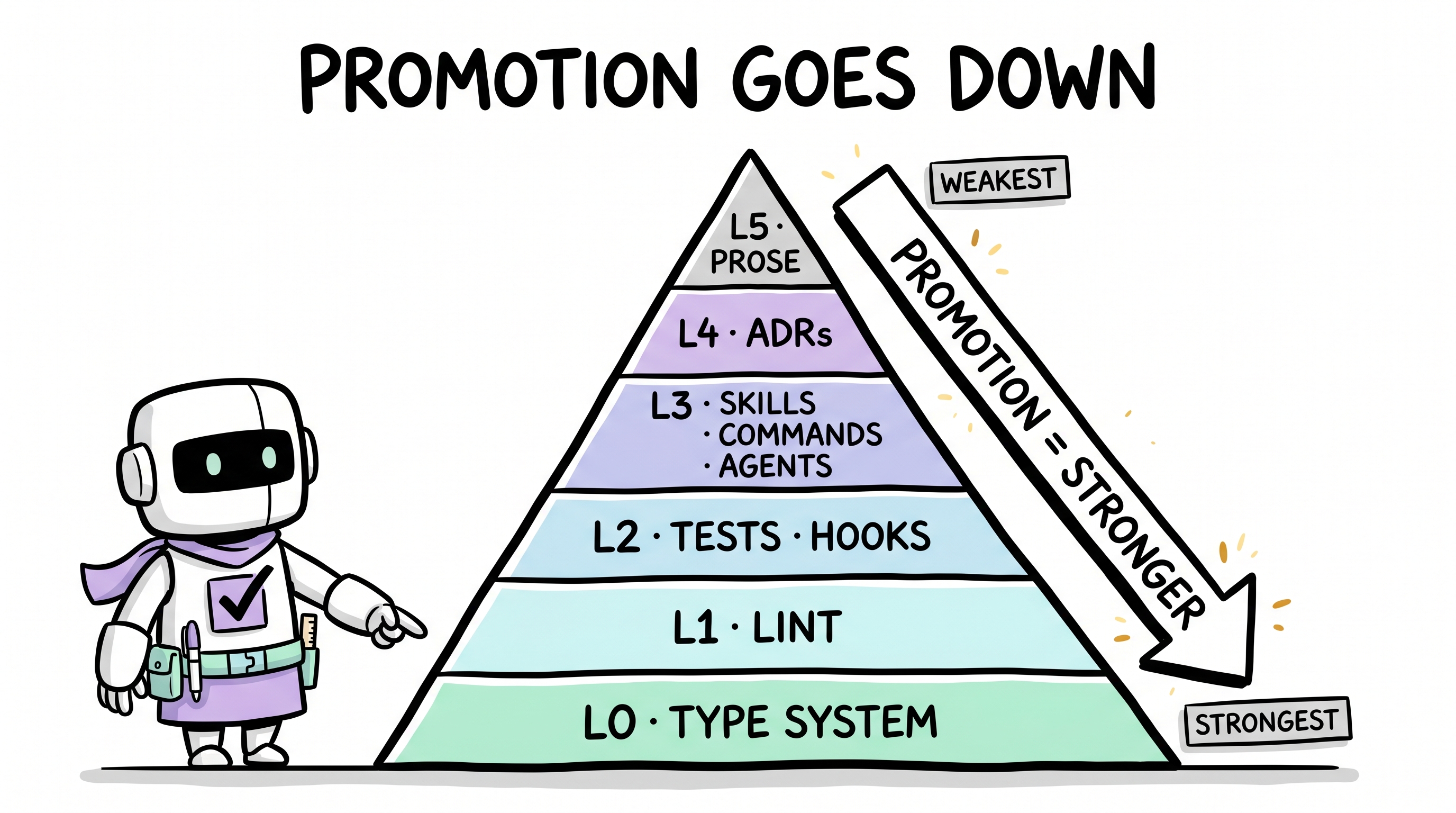
Archon's quality model has six layers, strongest at the bottom:
| Layer | Vehicle | Enforcement |
|---|---|---|
| L0 | Type system | Compilation impossible if violated |
| L1 | Lint / static analysis | Red in CI |
| L2 | Editor rules, tests, pre-commit hooks | Red in IDE / CI |
| L3 | Skills, commands, agents | Loaded at relevant wake |
| L4 | ADRs | Recorded decisions |
| L5 | Prose documentation | Human-readable only |
Promotion direction is always downward (stronger). A reasoning capsule that becomes a lint rule moves from L3 → L1. Documentation is the last resort, not the first.
6. The state discipline
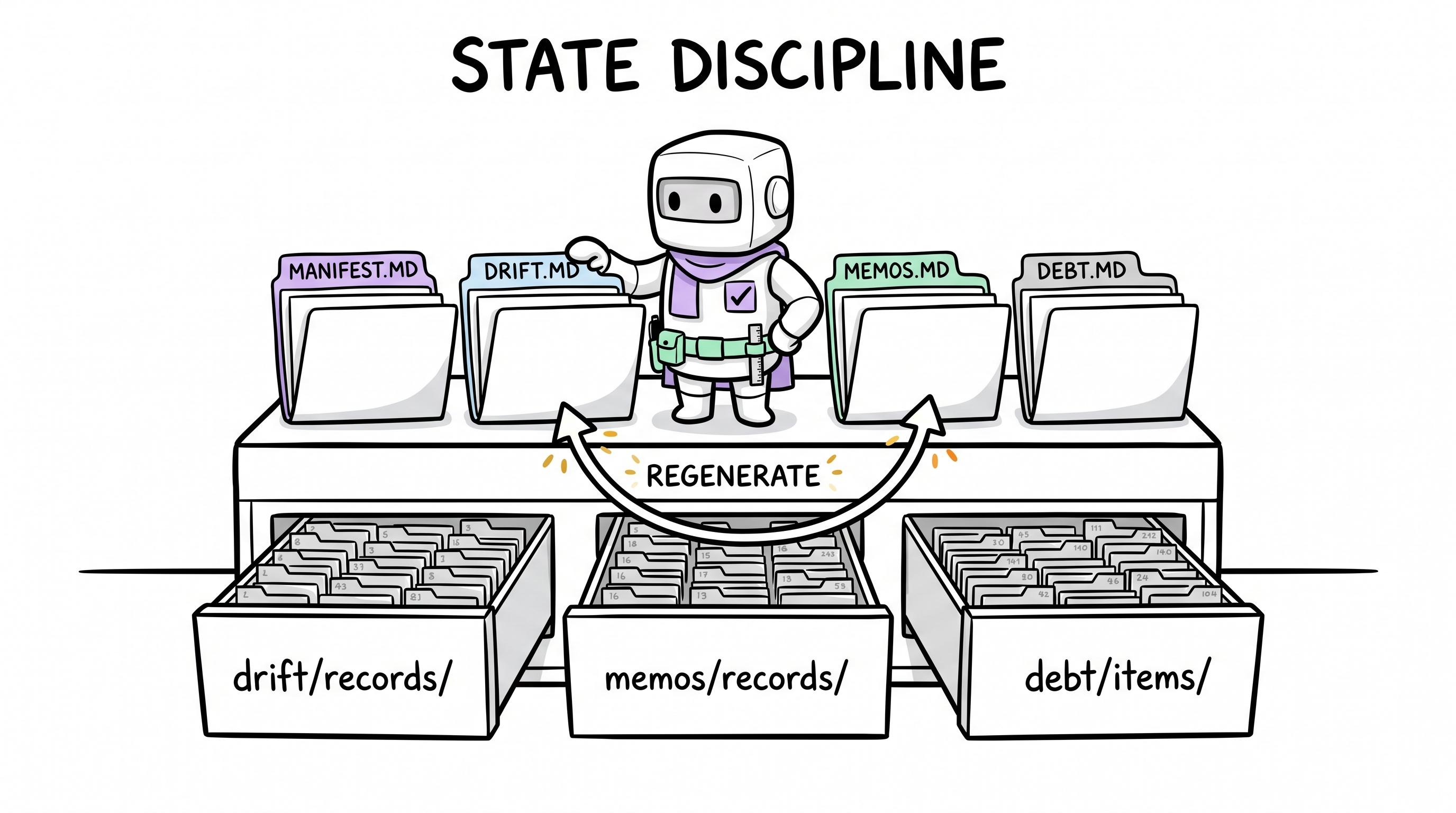
Four state files + three records folders keep project truth between sessions:
| File | Role |
|---|---|
| manifest.md | Hot project context: concept glossary, user language aliases, current state, validation command, tech stack, knowledge asset index. The only Archon file allowed to contain project specifics. |
| drift.md | Memory-decay alarm. Counter of deliveries since the last review, tiered thresholds (Light / Full / Emergency). |
| memos.md | Stakeholder memos. Vetoes, decisions, clarifications. Auto-scanned at demand pre-scan. |
| debt.md | Unresolved responsibility. Milestone gate reads here. |
Per-event records under .archon/{drift,memos}/records/ and .archon/debt/items/ are the immutable source of truth (ADR-22, event-sourcing). The hot summary files are regenerated from records — concurrent PRs no longer collide on them.
Read mechanisms/drift-mechanism.md for the full drift story.
7. How Archon evolves itself
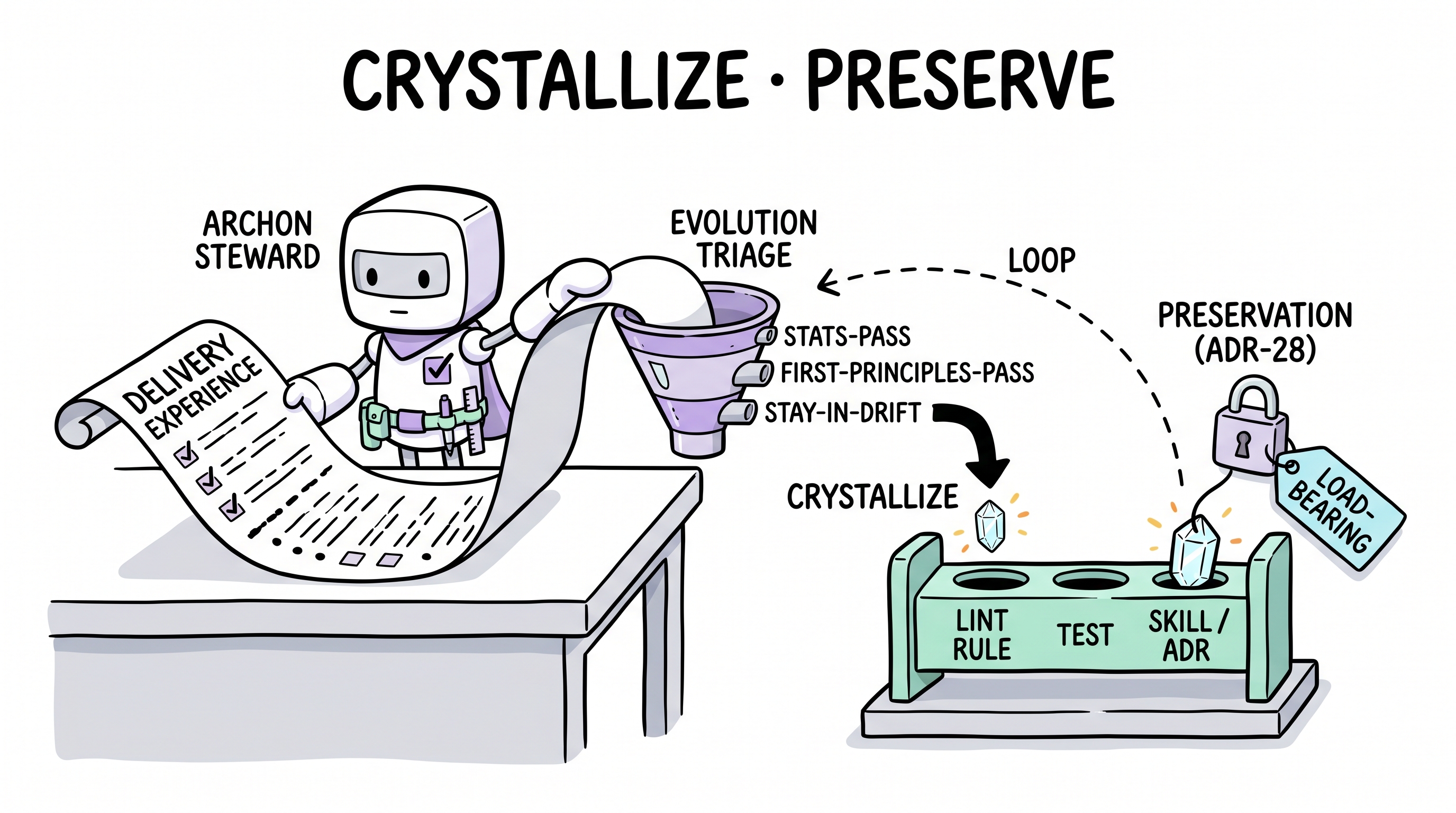
Archon doesn't just execute deliveries — it metabolizes them. At Close-Out, every delivery passes through an evolution triage:
- stats-pass — statistical signal (Rule of Three or recurrence). Promote to the strongest fitting vehicle.
- first-principles-pass — a core assumption was falsified. Capture with explicit validation experiment.
- stay-in-drift — one-off or weak sample. Stay as experience record.
Promotion follows the Constraint Pyramid. A repeated null-check bug doesn't become "a note in drift" — it becomes a lint rule (L1) or a characterization test (L2). The Claim Verifier (scripts/archon-claim-verifier.mjs) mechanically cross-checks the agent's written claims against in-repo truth to stop governance prose from drifting from reality.
The dual motion:
- Crystallization — turn experience into a stronger constraint.
- Preservation (ADR-28) — actively pin load-bearing knowledge with a mechanical triple (critical-rule registry anchor + body-shape test + portable-contract entry), so useful knowledge is not silently deleted.
8. Where to go next
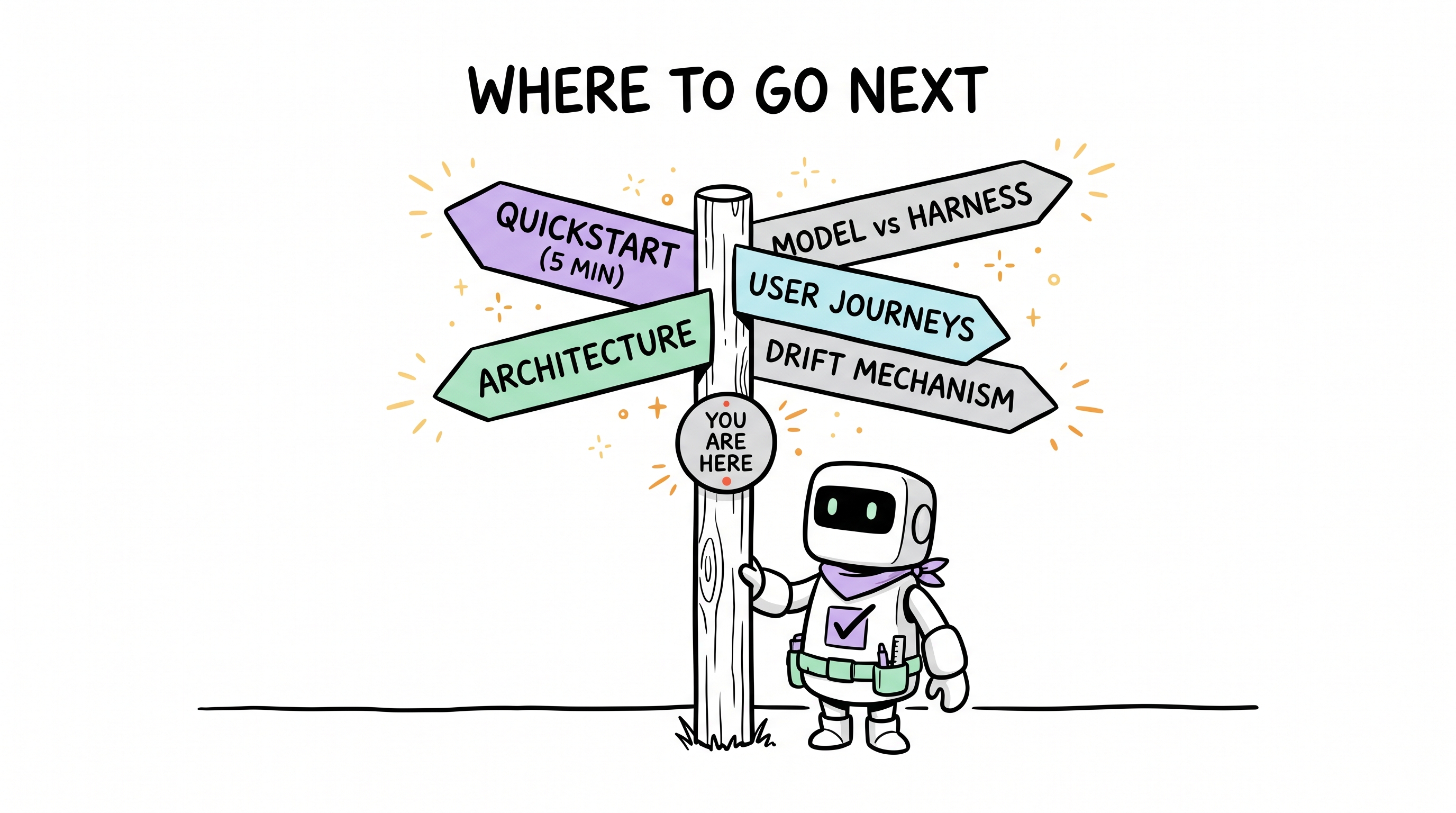
| I want to... | Read this |
|---|---|
| Install Archon in my project | adoption/quickstart.md (5 min) → setup.md (full detail) |
| Understand the full architecture | architecture.md |
| See the framework decision log | decisions.md |
| See 16 real-world pain points it addresses | user-journeys.md |
| Understand drift in depth | mechanisms/drift-mechanism.md |
| Compare Archon vs a skill library | concepts/superpowers-comparison.md |
| Read the "model isn't enough" argument | concepts/model-vs-harness.md |
| See how refactoring disciplines were adapted | concepts/refactoring-adoption.md |
| See how Archon looks as a product | concepts/product-architecture-workflow.md |