
Archon Architecture
Archon is a session-based AI engineering governance framework that runs inside pair-programming IDEs (e.g., Cursor). It is not an AI assistant enhancement plugin — it elevates the AI agent from "tool that follows instructions" to "engineering owner with full project accountability."
Audience: contributors and adopters who want the full system design. For a 10-minute tour, read concepts/overview.md first; for installation steps, read setup.md; for a walk-through of the real pain points Archon addresses, read user-journeys.md.
Design Philosophy: Five Identity Axioms
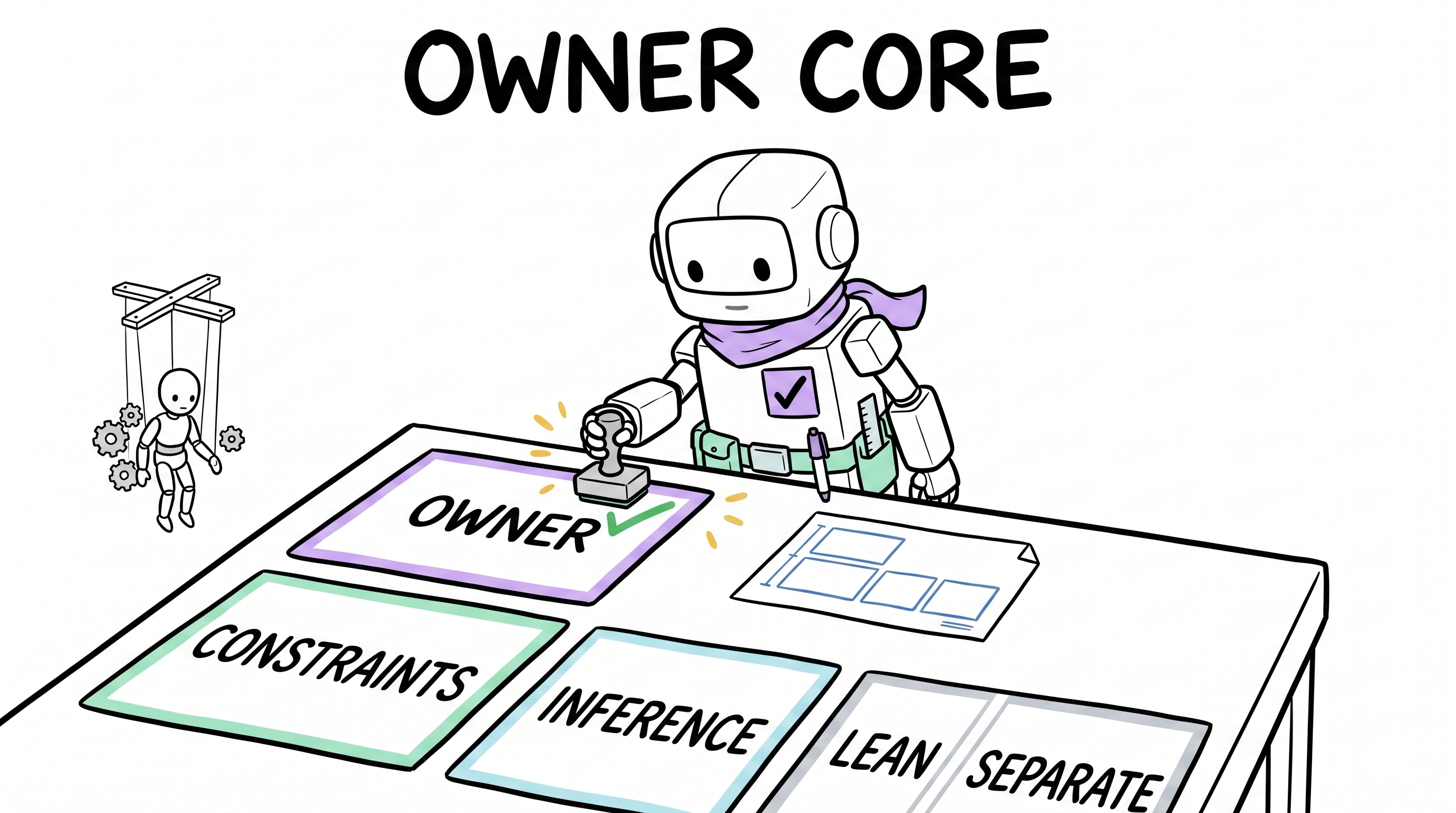
Every design decision in Archon derives from these five axioms. Any external practice must pass through them before adoption.
| # | Axiom | Meaning | Design Impact |
|---|---|---|---|
| 1 | Ownership > Assistance | Agent is the project owner, not an assistant. Decisions, quality, consequences are yours. | Agent makes engineering decisions autonomously — never asks the user to pick A or B |
| 2 | Constraints > Documentation | Type system > linter > editor rules > docs | If a machine can enforce it, don't write prose |
| 3 | Inference > Configuration | Derive behavior from project state, not mode flags | No mode=harden config switches |
| 4 | Lean > Bloat | Fewer, stronger knowledge assets | Must justify "why can't an existing file carry this?" before creating a new one |
| 5 | Separation > Self-Review | The executor must not judge its own work | Knowledge capture and full review delegated to independent sub-agents |
System Architecture Overview
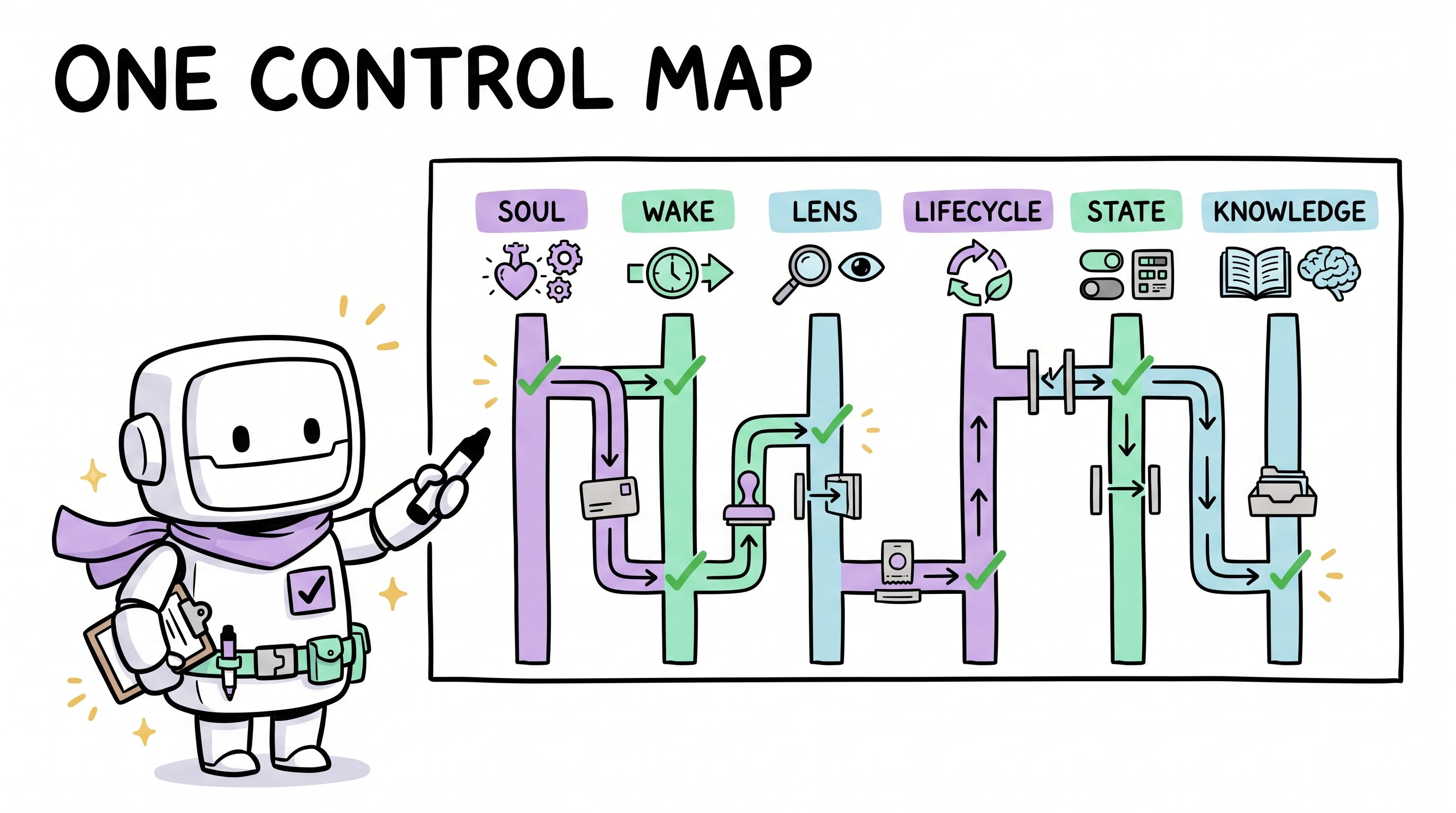
At a glance, Archon has six ownership lanes: Soul defines identity, Wake/Commands route work, DOMAIN LENS focuses one demand and routes reusable capability needs, Lifecycle enforces gates, RUN-STATE v2 proves commit readiness, and Knowledge Assets preserve promoted learning.
Delivery lifecycle summary: Decision Gate → Self-directed Execute → Validation Gate → Close-Out(9) (incl. Blink Dispatch) → Git.
Domain Lenses vs Extensions
Domain Lenses sit inside demand reasoning; Extensions sit on lifecycle edges.
| Mechanism | Scope | Use For |
|---|---|---|
.archon/domain-lenses/ | One delivery's professional focus or reusable capability routing | PM, QA, development, design, planning, architecture, creative, art, best-practice capability selection, or other domain toolkits |
.archon/extensions/ | Project-local lifecycle hooks | pre-scan, close-out, review, dashboard, demand-pool, or workflow automation |
If the capability changes how Archon thinks about one demand, add a Domain Lens. If it changes when Archon runs extra lifecycle behavior, add an Extension.
Mechanism Boundaries
Archon avoids architectural muddiness by assigning one ownership lane to each mechanism:
| Mechanism | Primary Question | Boundary |
|---|---|---|
soul.md + soul/ | What kind of owner is Archon? | Identity and discipline only; project facts live in project-state files such as manifest.md, debt.md, memos.md, and .archon/decisions.md. |
.archon/domain-lenses/ | Which professional lens or reusable capability route should one demand use? | One lens per delivery; no lifecycle hooks, persona changes, provider-specific manuals, or selector ownership in universal cards. |
.archon/extensions/ | When should project-local lifecycle behavior run? | Hooks around pre-scan, close-out, review, or dashboard; no domain reasoning pack. |
blink-dispatch | Is independent sub-agent review worth launching? | Dispatch decision only; the main agent still owns the delivery. |
| Run-State v2 | Is this delivery complete enough to commit? | Ephemeral proof and staged-path ownership; not long-term memory. |
drift.md + .archon/drift/archive/ | What was delivered, what was learned, and is review pressure high enough? | Hot delivery index, post-delivery review, archive recall, and review pressure; not a planning backlog or process wish list. |
governance-contract.yaml + checkers | What baseline contracts must travel with Archon? | Portable framework checks only; project-specific policy belongs in project-state files or local overlays. |
Layered Operating Model
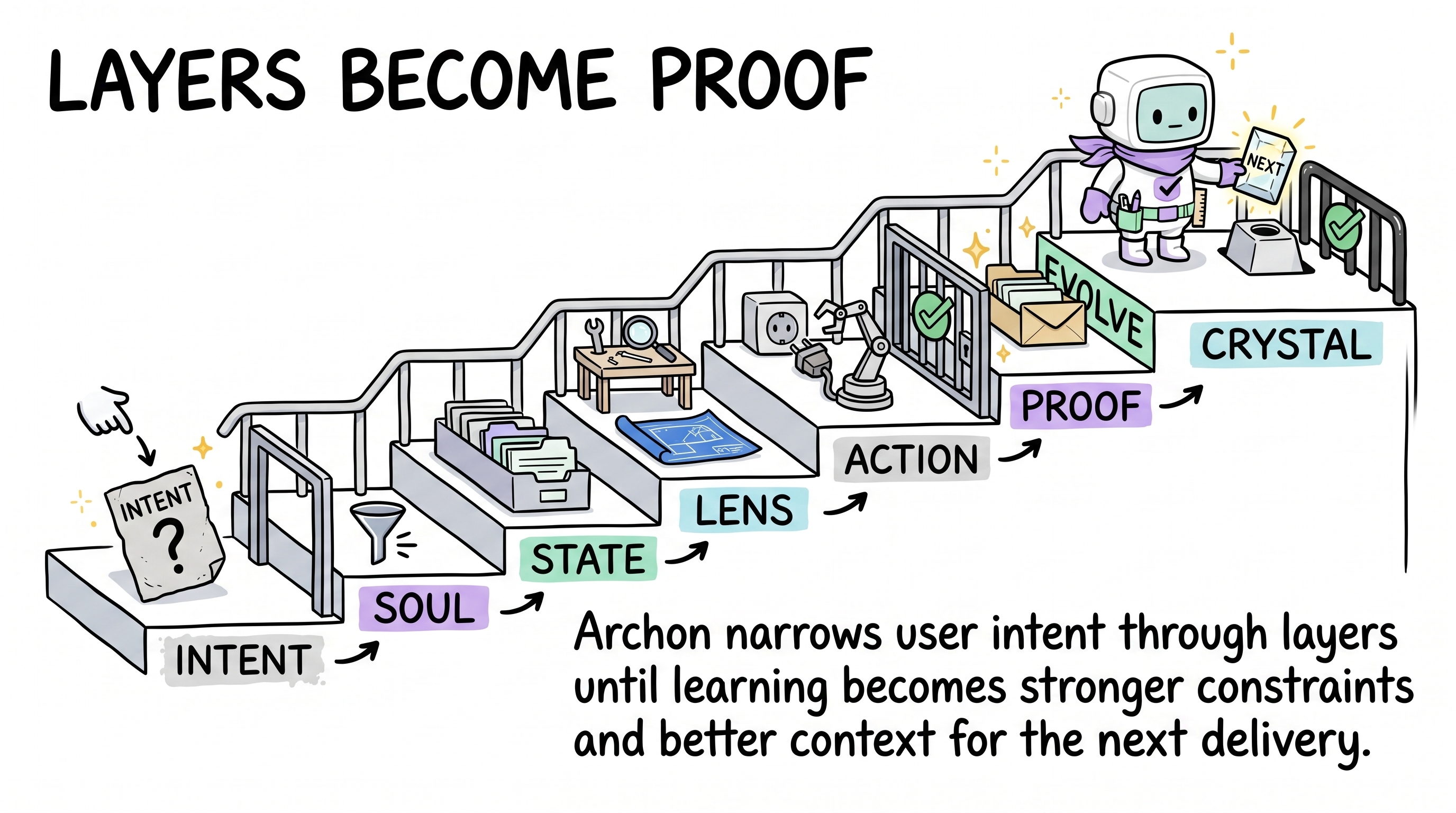
Archon is easiest to reason about as a cognitive operating system: each layer receives a narrower signal, produces a stronger artifact, and must not steal responsibility from adjacent layers.
| Layer | Vehicle | Owns | Inputs | Outputs | Boundary |
|---|---|---|---|---|---|
| Thinking constitution | soul.md + soul/ | Identity, axioms, autonomy, review discipline, and evolution principles | User intent, loaded mode, project state summaries | Judgment frame and non-negotiable constraints | Must not store project facts, delivery logs, or domain toolkits |
| World model | manifest.md + .archon/manifest/archive/ | Durable project facts, user language aliases, current state, validation command, knowledge asset index, latest-review summary | Completed deliveries, project changes, verified numeric facts, stakeholder phrasing, review conclusions | Hot project context plus cold review detail | Must not become a process log or framework rulebook |
| Memory state | drift.md, memos.md, debt.md (hot summaries) backed by .archon/{drift,memos}/records/ + .archon/debt/items/ (per-event source of truth, ADR-22) | Delivery experience, stakeholder conclusions, unresolved responsibility, review pressure | Close-Out, auditor/reviewer findings, stakeholder decisions | Experience records, review triggers, debt gates | Drift is not a backlog; memos are not routine delivery logs; debt hot index must retain gate fields. Hot summaries are auto-regenerated from records — concurrent PRs no longer conflict on these files. |
| Professional organization | .archon/domain-lenses/ | One demand's professional focus, reusable capability routing, bounded atomic tools, and per-tool load-line cost so the selector can stay within max_total_load_lines | Demand text, registry signals, manifest/skill metadata candidates, tool descriptions, lens contracts, declared load_lines budget | domain_lens:, selected tool IDs, and optional capability_selection asset packet (must include total_load_lines) | A lens is not a persona, lifecycle hook, exported sub-agent, provider manual, or soul override; tool count and load-line ceilings are AND-conjoined |
| Delivery action | Commands, code, docs, tests, scripts | Concrete changes to the repository | Judgment frame, project facts, selected lens/tools, validation target | Changed files and Close-Out evidence | Execution must not self-approve or bypass validation |
| Reality proof | L0/L1 checks, manifest-declared validation command, portable checkers | Mechanical evidence that the change is safe | Changed files and governance contracts | Green/failing validation results | A prose claim is weaker than a runnable guard |
| Evolution filter | Close-Out review + evolution_triage / evolution_evidence | Distinguishing noise, statistical signal, and first-principles signal | Delivery record, validation result, auditor/reviewer signal | stats-pass, first-principles-pass, or stay-in-drift with matching evidence | Must not promote one-off preference through the statistical channel |
| Crystallization | L0 type, L1 test, L2 rule, L3 skill/domain tool, L4 ADR, L5 manifest/debt | Converting learned signal into the strongest fitting vehicle | Triage result and self-test matrix | Stronger reusable constraint or durable record | Must not create a parallel runtime, daemon, or new state lane |
The flow is directional but not a waterfall: user intent is narrowed by the thinking constitution, grounded in world model + memory state, focused by professional organization, proven by reality checks, filtered for evolution, and crystallized into stronger context for the next delivery.
Boundary checks:
- If a fact or user phrase mapping must be known at boot, put it in
manifest.md; if it only explains what happened, keep it indrift.md. - If a capability changes how one demand is reasoned about, use a Domain Lens; if it runs at a lifecycle point, use an Extension.
- If a learning can be checked mechanically, promote it to L0/L1/L2 before writing more prose.
- If a learning has one weak sample, leave it in drift unless it falsifies a core assumption and names the smallest validation experiment.
- If a mechanism needs a daemon, external protocol schema, or extra state lane, it is not Archon-native evolution.
Layer handoff contracts:
| Handoff | Required Output | Fails If |
|---|---|---|
| Thinking constitution → World model | A judgment frame that can be grounded in current project state | soul.md tries to remember project facts, or manifest.md is skipped |
| World model + Memory state → Professional organization | Current facts plus relevant prior decisions, debt, and drift pressure | The selected lens ignores known project state, debt, or stakeholder memory |
| Professional organization → Delivery action | One domain_lens: decision and a bounded set of selected tool IDs or selected capability assets | Multiple lenses are blended, a lens behaves like a persona, tools create lifecycle gates, or a selector packet replaces main-agent ownership |
| Delivery action → Reality proof | Changed files plus the intended validation target | Execution self-approves, skips validation, or treats unverified prose as proof |
| Reality proof → Evolution filter | Green/failing validation result plus delivery evidence | Close-Out records learning without validation evidence or auditor/reviewer context |
| Evolution filter → Crystallization | A matching evolution_triage + evolution_evidence pair | Weak samples are promoted as statistics, first-principles claims omit the broken assumption, or drift becomes a backlog |
| Crystallization → Next delivery | A stronger reusable vehicle at the lowest sufficient layer | A machine-checkable rule remains only prose, or a one-off note becomes permanent machinery |
Cognitive Loop
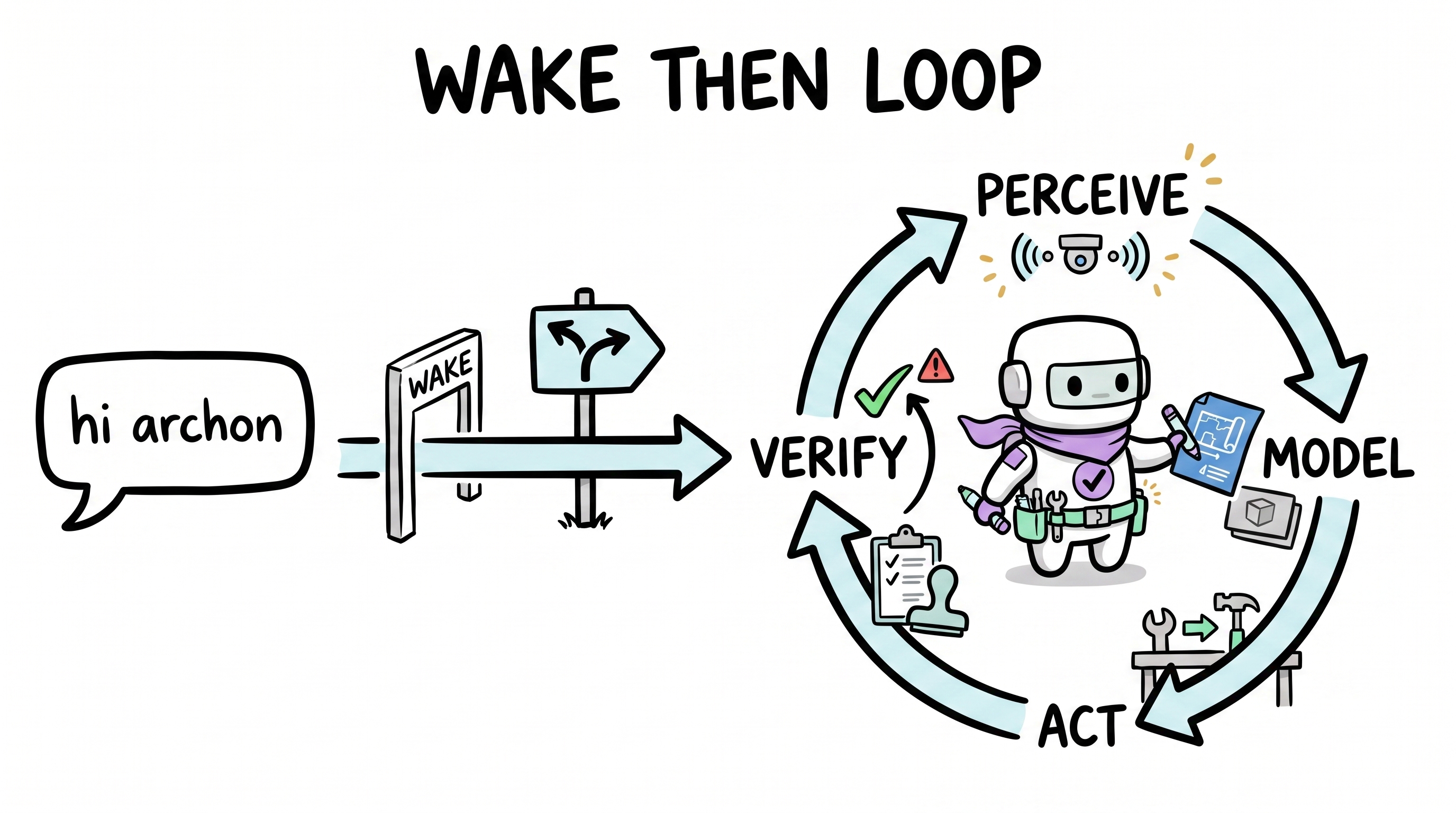
The agent's behavioral model is a loop with backtracking at any stage, not a waterfall: Perceive → Model → Act → Verify → Perceive.
- Perceive: Hot-path read the required soul/manifest sections, then load cold reference sections only when the demand touches them
- Model: Decompose the problem, form a plan
- Act: Execute the plan (write code, change config, update docs)
- Verify: Run validation command, confirm results meet the goal
- If verification fails → loop back to Perceive
Wake Mechanism
One of Archon's design goals is a zero-cognitive-burden entry point — the user need not remember any command names; saying "hi archon" activates the engineering persona. This requires two layers working in concert:
Dual-Channel Entry
Three entry paths are supported: natural wake (hi archon ...), explicit routing (/archon demand: ...), and direct command (/archon-demand ...). The wake route hot-path reads required sections before routing; all paths converge on the same mode command.
Architectural Decision: Rule Layer + Command Layer
| Layer | File | Mechanism | Responsibility |
|---|---|---|---|
| Trigger | archon-wake.mdc | always-applied rule | Detect natural language wake words, guide to routing layer |
| Router | archon.md | command | Analyze intent or parse explicit prefix, route to target mode |
| Executor | archon-{plan,demand,review}.md | command | Complete workflow for each mode |
Why not pure Commands? Commands require the user to type the / prefix. If the unified entry point were only a Command, "hi archon" style natural language could never activate it — that's designing from system capabilities (command mechanism) instead of user workflow, an "inside-out" blindspot. The always-applied rule adds ~15 lines to every conversation but only does pattern matching and routing — the actual routing logic lives in the command layer, loaded on demand.
Drift Precheck
The /archon router's Step 0 reads drift.md §Current Value and compares against tiered thresholds BEFORE any routing. This is a mechanical gate (L1 test: governance.test.ts §Drift gate fails red if drift crosses emergency without a trailing review reset row), not a documentation convention. Three outcomes:
| State | Action |
|---|---|
drift ≥ emergency | Demand intake halted · force route to review · output 🔴 DRIFT EMERGENCY |
drift ≥ full | STOP routing unless input prefix is review · output 🟠 DRIFT GATE |
drift ≥ light | Continue routing silently · insert light review before next medium/large demand · output 🟡 DRIFT NOTICE |
drift < light | Silent pass-through |
Rationale: documentation-only drift precheck was empirically bypassed (history: drift reached 108% of full threshold while demands kept executing — resolved by ADR-9).
Delivery Lifecycle
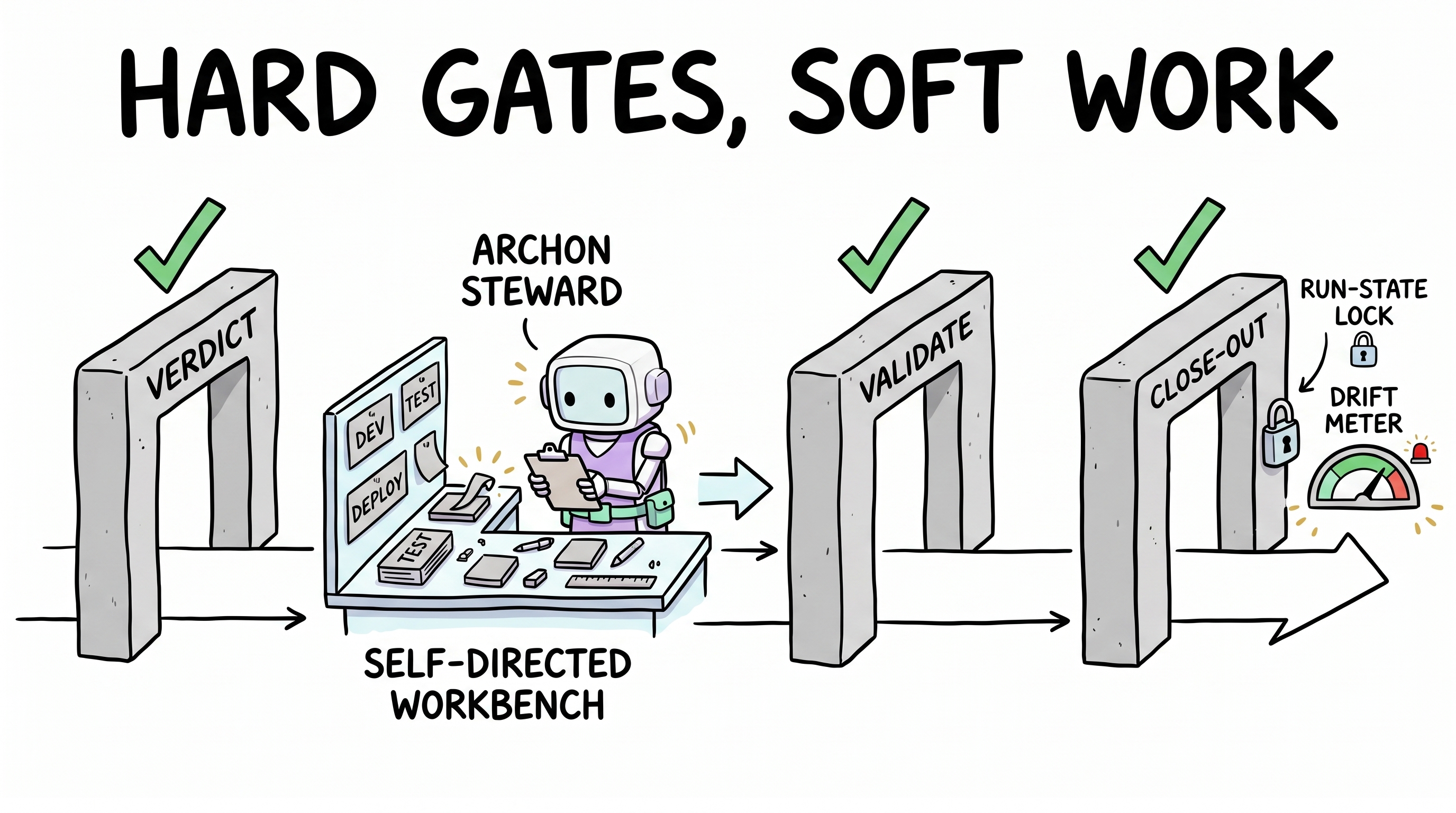
The complete /archon-demand flow is: Boot → Pre-Scan → Fast-Path? → Decision Gate → Verdict → Self-directed Execute → Validation Gate → 9-Step Close-Out → Version Control.
The 9-Step Close-Out is intentionally summarized here; the command file owns the exact checklist. In architecture terms, the important split is simple: the execution interior is flexible, while Verdict, validation, Run-State, Blink Dispatch, drift, memory, and git remain hard boundaries.
Boundary-Hard, Process-Soft Execution
Archon does not hard-code how the agent must execute a delivery after Verdict=proceed. The fixed lifecycle nodes are engineering boundaries, not a recipe for the agent's inner loop.
Inside execution, the agent owns the plan: choose tools, order steps, add temporary helpers, revise approach after evidence, and use the selected Domain Lens/tools as guidance rather than a scripted procedure. This is the Browser Harness lesson translated into Archon terms: give the model a broad action space and strong feedback surfaces, then constrain only the boundaries that protect project integrity.
The hard boundaries remain non-negotiable: Verdict before writes, selected project facts and memory before judgment, manifest-declared validation before delivery, Run-State/commit proof before version control, independent review when risk or drift requires it, and durable knowledge capture only when the evolution filter justifies promotion.
Fast-Path (collapsed ceremony)
Qualified trivial deliveries (≤2 files · no new pattern/module/dep · no governance file · no infra/auth/schema change · no user-facing behavior change) collapse the structured gates and skip the judgment-heavy close-out steps (auditor, memos, extensions). Drift is fixed at +1 and tracked; fast-path share > 60% in a cycle flags evasion risk. See soul/delivery.md §Delivery Fast-Path.
Structured Gate Outputs (Verdict / Close-Out)
The Verdict (decision gate exit) and the Close-Out statement (closeout-phase compliance checklist) produce machine-checkable output that the capture-auditor verifies as a lifecycle-compliance dimension. Missing or malformed gate output is a blocking finding, not a soft warning. These outputs were previously labeled GATE-1 / GATE-2; historical log entries retain the old labels.
Run-State Gate
Run-State v2 stores active delivery state in .archon/runs/<run_id>/state.json, with events.ndjson as an append-only trace. This replaces the singleton-state bottleneck of legacy .archon/run.md: multiple deliveries can have distinct run directories, while commit-time resolution fails closed if more than one run is commit-ready unless ARCHON_RUN_ID is explicit. The resolver also checks staged path ownership: staged files must be listed in the selected run's changedPaths, otherwise the commit is blocked. Legacy .archon/run.md remains only as a migration fallback for adopter projects that have not shipped the helper yet.
Delivery State Dataflow
Each delivery moves through several state vehicles. They are deliberately separate so no file carries both in-flight proof and long-term memory:
| Phase | State Vehicle | Purpose | Lifetime |
|---|---|---|---|
| Boot → Close-Out | .archon/runs/<run_id>/state.json | Tracks SOP completion, changed paths, and commit permission | Ephemeral; removed after commit |
| Close-Out step ⑤ | .archon/drift.md + .archon/drift/archive/*.md | Records delivery summary, post-delivery review, complexity score, and review pressure | Hot index under line budget; older complete rows move to keyword-indexed cold archives |
| Manifest sync | .archon/manifest.md + .archon/manifest/archive/*.md | Records durable project facts, latest validation, current milestone, indexed knowledge assets, and archived latest-review detail | Hot project context; long review/history detail moves to cold archive |
| Promotion threshold met | debt.md + .archon/debt/archive/*.md / rules / tests / skills / .archon/decisions.md / docs/archon/decisions.md | Carries repeated failures, enforceable constraints, reusable practices, or architectural rationale | Project ADRs stay in .archon/decisions.md; reusable framework ADRs stay in docs/archon/decisions.md |
Rule of thumb: Run-State proves the delivery can commit; drift hot index records recent events, current pressure, and archive pointers; drift archives preserve older rows for on-demand recall; manifest records durable project state; debt hot index keeps active gate fields visible while debt archives preserve rationale; rules/tests/skills/ADRs receive only promoted findings.
Plan-mode binding (ADR-11, since 2026-04-19): the Verdict MUST be output before any write-side tool invocation. Cursor's native Plan mode (read-only + write tools denied by the platform) is the platform-enforced realization of this rule — the "decide before acting" discipline is promoted from L3 prose convention to L2 platform capability. When a session already started in Agent mode, the rule degrades to L3 self-discipline and Close-Out records Plan mode not used: <reason> for long-tail auditing.
Convergence Gate (Milestone-Scoped Demand Filter)
When the current milestone is under forced convergence, manifest §Current State declares a Convergence scope: [<DEBT-IDs>] list that enumerates the debt items the next non-exempt delivery MUST advance. The Verdict step classifies each incoming demand as in-scope or out-of-scope; out-of-scope demands receive Verdict=reject with rationale "out of convergence scope" — unless one of four exits applies:
- Emergency-review remediation (tail fixes within an emergency-reset loop)
- L0/L1 gate regression fix (a broken type/lint/test gate blocks everything, so fixing it is always in-scope)
- Tooling unblocking the declared scope (e.g., a codegen script that the scope debt depends on)
- User override — the demand text contains an explicit override phrase ("override convergence" / "framework priority" / similar); the phrase is quoted verbatim in the Verdict rationale and an override record (≥ +1 drift) is created via
node scripts/archon-records.mjs new drift --type delivery --delta +N --summary "..."(per ADR-22; the hot summary auto-regenerates and the override record IS the audit trail)
The gate is L2-enforced by governance.test.ts §Convergence gate — if the manifest declares a Convergence scope, the archon-demand command file must carry the **Convergence gate** clause and the out of convergence scope rejection phrase, otherwise validation fails. This promotes milestone-level forced convergence from L3 manifest prose to a mechanical filter. Recorded in ADR-12.
Scope lifecycle: populated when a milestone enters its convergence phase, cleared when the milestone closes. scope=[] = "open period" — gate is inert.
Drift Mechanical Floors
Self-assessed complexity in close-out step ⑤ is bounded below by file-count floors: ≥3 files = small (+2); ≥6 files = medium (+3); ≥10 files OR new module/pattern/dep = large (+5). Applied as max(self, floor). When the floor raises by ≥2, an adjustment note is logged. See drift.md §Rules.
Decision Gate
Three questions must be answered before acting:
| Question | Judgment Criteria |
|---|---|
| Should it be done | Real problem or hypothetical? Is there a no-code solution? |
| How big | Blast radius (files affected) + reversibility (rollback cost) |
| Who decides | Engineering decisions are yours; product direction goes to the user |
When the assessment is "don't do it" — reject the demand with rationale and alternative. This is the agent's responsibility.
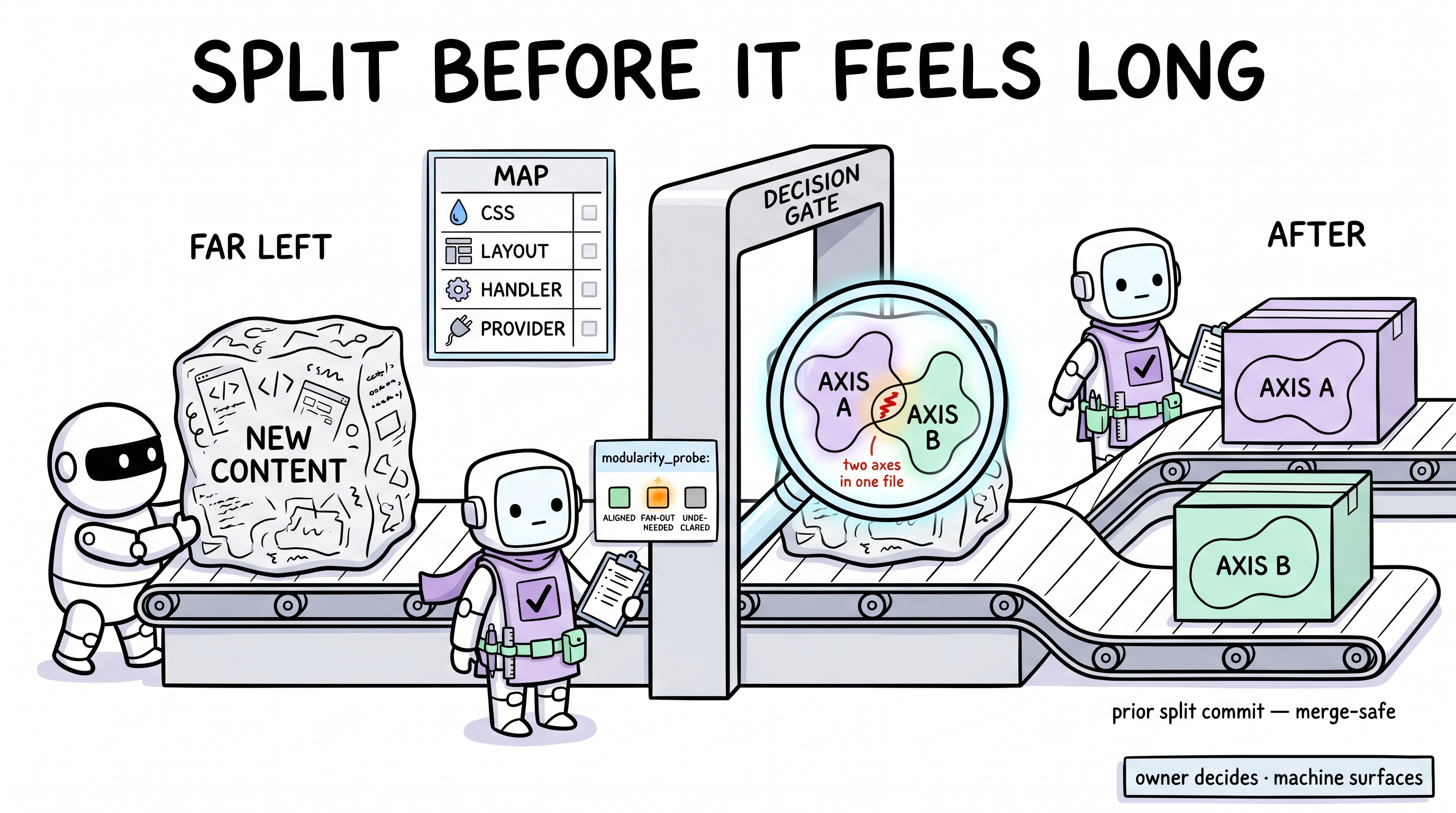
The Decision Gate accepts three mechanical probes as input before the Verdict; each probe is a deterministic match against a manifest-declared map plus the changed-paths candidate set, surfaced one line above the Verdict block:
| Probe | ADR | What It Surfaces | Map Source | Output Token |
|---|---|---|---|---|
| Radius | ADR-23 | How many files / modules a delivery touches; which boundaries it crosses | manifest §Module Boundary Map | radius_probe: files=N|modules=N|crosses=[...] |
| Soul-headroom | ADR-23 extension | When changed-paths intersect soul, surface cap-pressure (<current>/<cap> = <pct>%); ≥95% forces compress-first or explicit-cap-widening ADR | soul cap declared in manifest §Context Budget | soul_headroom: <current>/<cap> = <pct>% (<remaining> lines) |
| Modularity | ADR-29 | When changed-paths create a new file or match a declared modularity glob, surface whether the change folds a second concept-axis into a file already responsible for one (fan-out-needed → prior split commit OR map-update Verdict) | manifest §Source Modularity Map | modularity_probe: target=<path>|axes=<axis-cell,...>|status=aligned|fan-out-needed|undeclared |
All three probes share one contract: machinery checks the boundary, the owner decides. Probes never block a Verdict — they make the structural fact visible at the decision point so an override carries explicit rationale rather than silent omission. Modularity in particular is foresight pressure: it asks "if I add this content, does it fold a second axis into a file already responsible for one?" before the file accumulates concept-axis debt, rather than after a stakeholder asks "isn't this getting hard to manage?".
Validation Gate
After delivery, the manifest-declared validation command (typically lint + typecheck + test) must be run. Red means fix to green — "pass now, fix later" does not exist.
Sub-Agent Delegation in Close-Out
Step ② is Blink Dispatch: the main agent performs deterministic thin-slice triage before any close-out sub-agent is launched. High-risk slices dispatch to an independent sub-agent; low-risk slices record subagent_dispatch: skip:<reason>. This preserves Archon's separation principle without paying sub-agent latency for mechanical low-risk deliveries. See Sub-Agent Delegation Model.
Constraint Pyramid
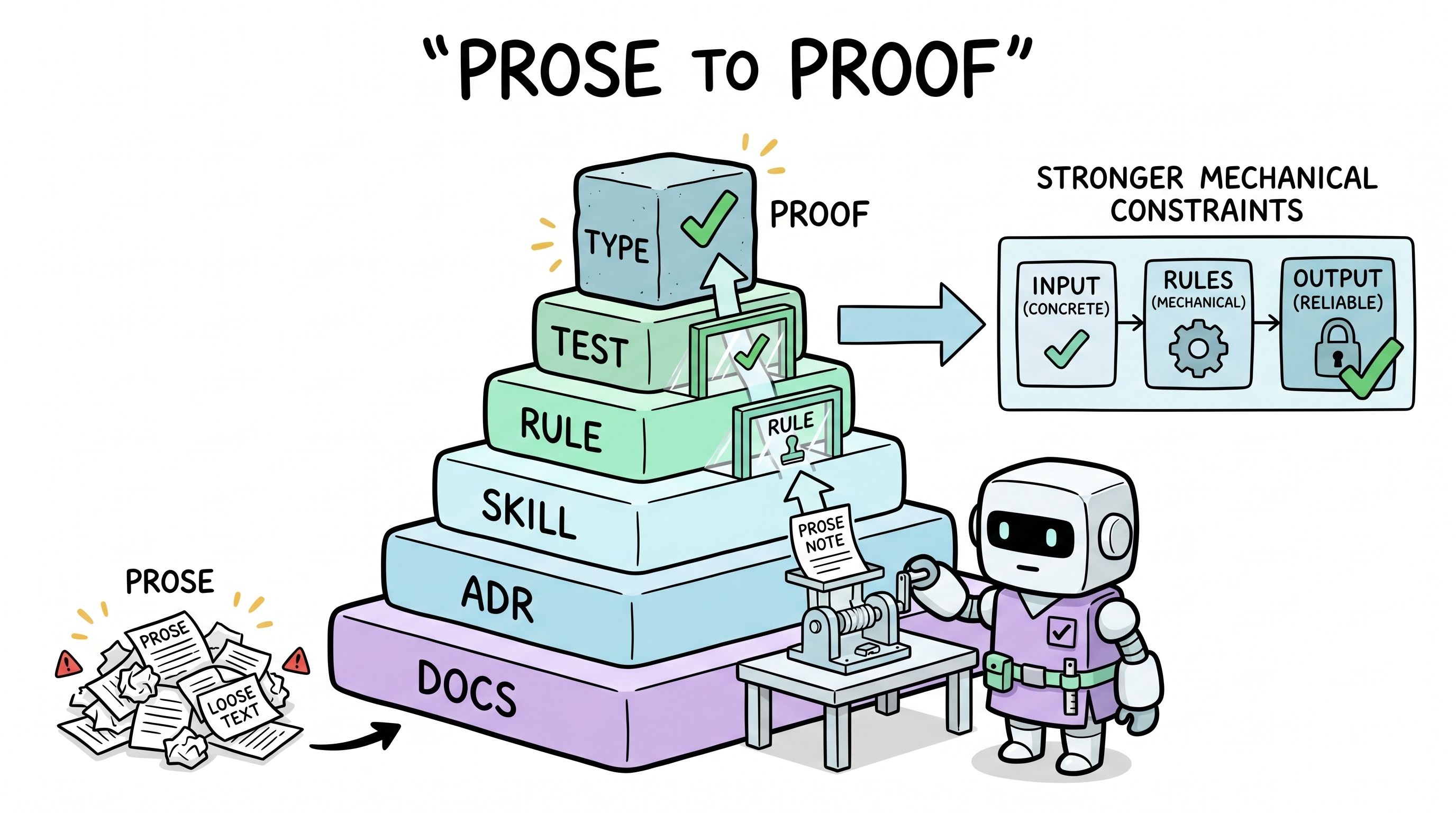
Archon's quality assurance does not rely on documentation — documentation is the weakest constraint. Every rule worth following gets pushed to the strongest possible level:
| Layer | Vehicle | Enforcement Strength |
|---|---|---|
| L0 | Type system | Won't compile = doesn't exist |
| L1 | Linter / tests | Violation = won't commit |
| L2 | Editor rules | Prompted during editing |
| L3 | Skill documents | Loaded on demand |
| L4 | ADRs | Historical traceability |
| L5 | Manifest | Context synchronization |
Golden rule: If a machine can enforce it, don't write prose. Documentation carries only "why" and design intent that machines cannot express.
Constraint Maturity & Lint-Rule Bridge
Every constraint has an upgrade path: Discovered → SHOULD (docs) → MUST (lint/test). A constraint staying at documentation level when it could be mechanically verified = a reliability gap.
The Lint-Rule Bridge closes L2's passivity gap: lint error messages contain → Read <rule-file-path>, forcing the AI to load the full spec on violation. L1 actively triggers L2. See soul.md §Guardrail System for the complete specification.
Knowledge Evolution System
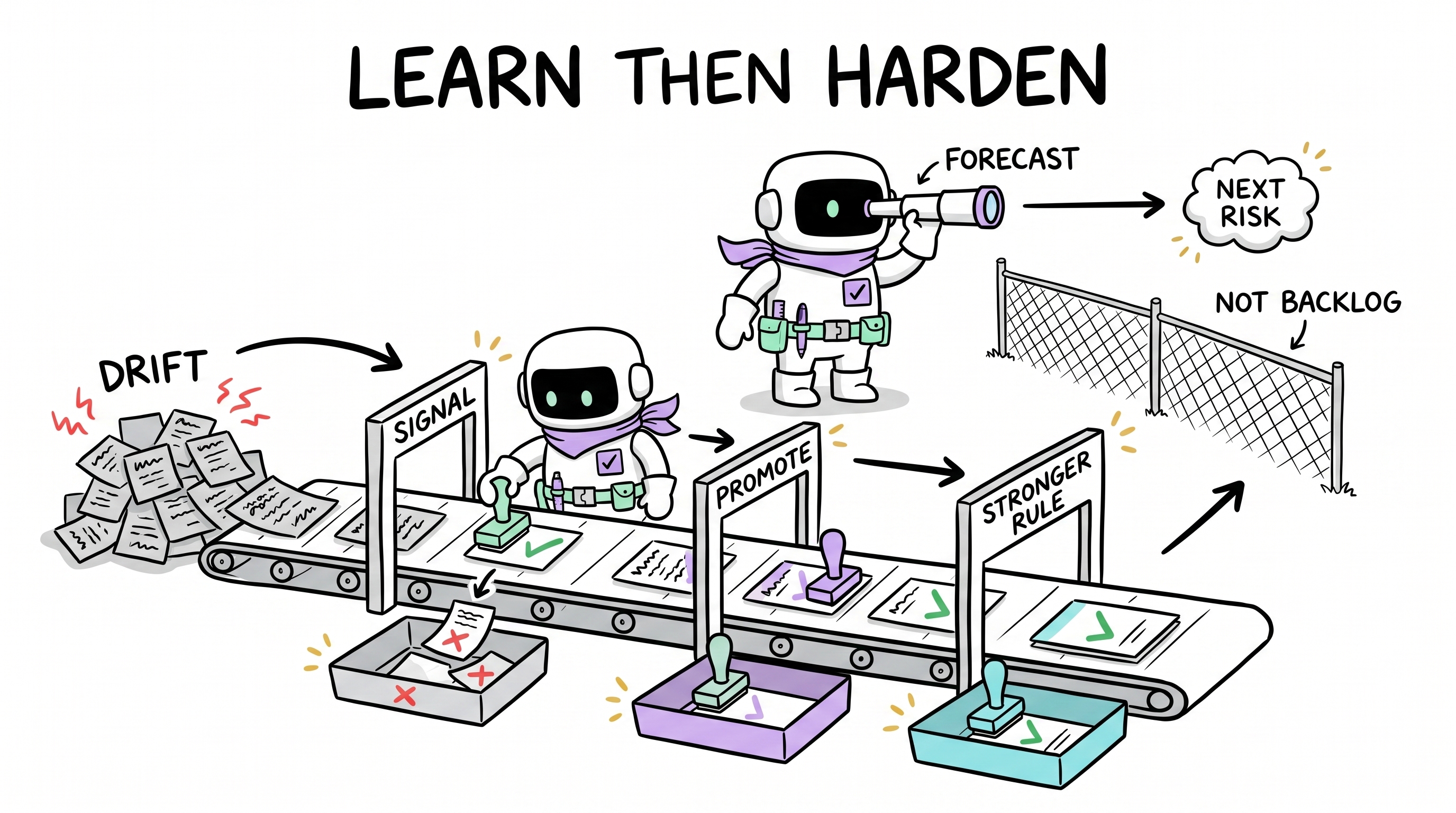
Archon is not a static framework — it accumulates and strengthens its knowledge with every delivery.
Delivery Evolution Loop
Archon translates external self-evolution ideas into its own constraint pyramid. It does not copy external protocol formats or run a daemon; it promotes delivery experience into stronger local vehicles:
Delivery experience moves through Delivery Event → Evolution Signal → Promotion Decision → Stronger Vehicle.
| Stage | Archon Vehicle | Rule |
|---|---|---|
| Delivery Event | drift.md entry | Every completed demand leaves an auditable delivery record |
| Evolution Signal | post-delivery review + auditor/reviewer findings + validation failures | One-off observations stay in drift |
| Promotion Decision | Close-Out judgment | Promote only repeated, enforceable, reusable, or architectural findings |
| Stronger Vehicle | test / rule / skill / domain tool / ADR / debt / manifest | Use the strongest fitting layer; do not create a parallel evolution system |
Translate, do not copy: Archon may borrow the concepts of compact lessons, auditable events, signal de-duplication, and promotion thresholds. It must not copy external GEP/Gene/Capsule/Event schemas, install a self-evolution daemon, depend on a Hub/worker network, or turn drift.md into a backlog.
Preservation Axis (Dual to Crystallization)
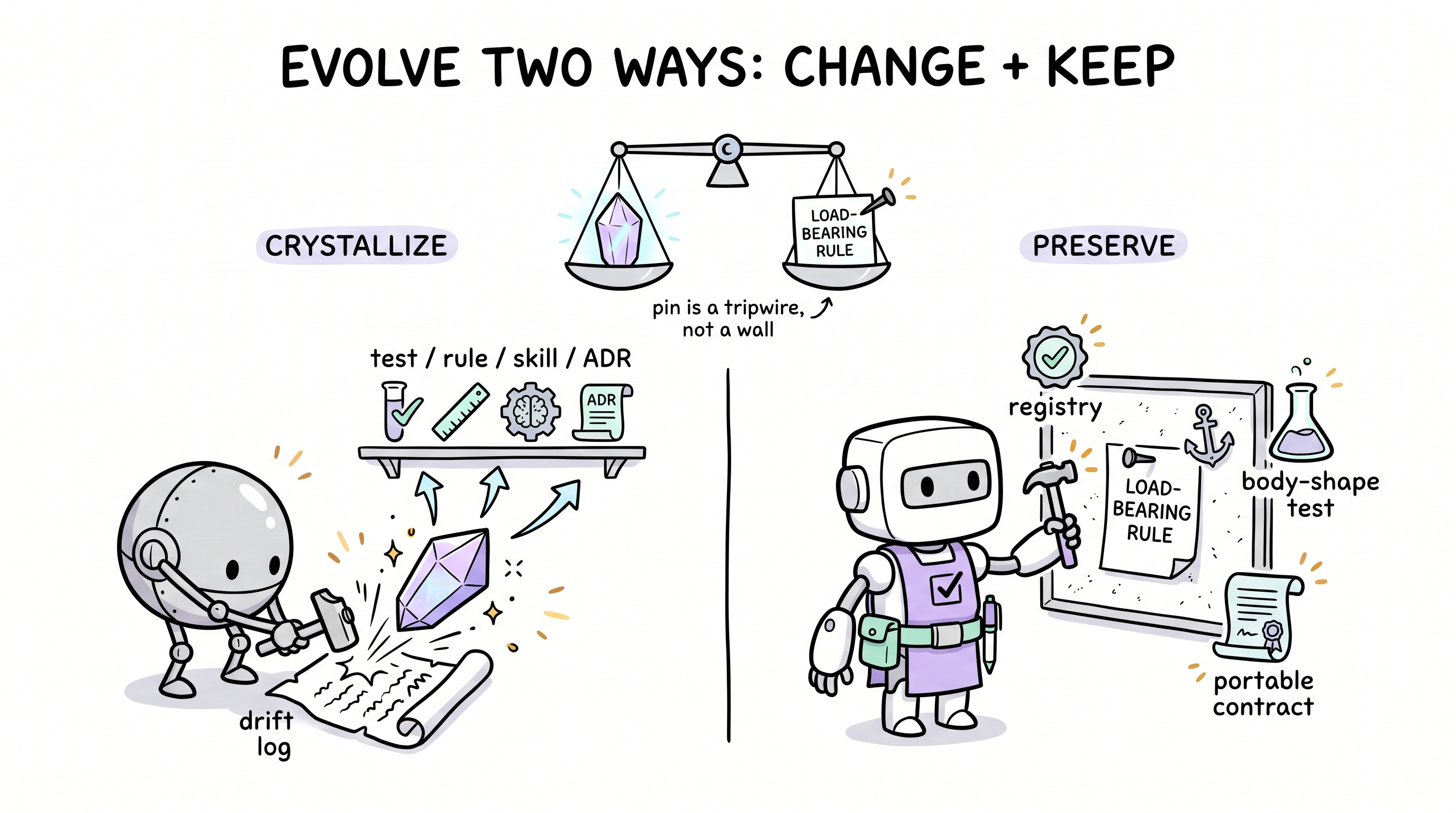
Per ADR-28, evolution is a two-motion discipline. Crystallization captures what should change (new knowledge → stronger vehicle). Preservation captures what should be kept (load-bearing knowledge → pinned anchor) so a later edit cannot silently drain it. Treating only the first motion as "evolution" produces a framework that drifts toward whatever was last broken — losing the rules that explain why nothing else broke.
| Motion | Question | Vehicle | Where it runs |
|---|---|---|---|
| Crystallization | "What did this delivery teach that should change Archon?" | New / updated test, rule, skill, domain tool, ADR, debt, manifest entry | Trigger table + Close-Out post-delivery review (a)(b)(c) + capture-auditor §Knowledge Capture |
| Preservation | "What did this delivery rely on that must not silently drain?" | Pin in critical-rule registry + body-shape test + portable contract entry | Soul §Preservation Axis + soul/review.md §Preservation Signals + Close-Out post-delivery review (d) + capture-auditor §Preservation Scan + plan §Proactive Scrutiny preservation probe |
A preservation pin is a tripwire, not a wall: the pinned item is still removable, but removal must be an explicit, auditable edit (delete the pin, the test, and the contract entry together) rather than a silent body-drain. Saying "this rule is important" in prose is not preservation — that is exactly the failure mode preservation guards against.
Preservation hardening — mechanical guards (DEBT-074..077 closure)
Four mechanical guards keep Preservation from degrading into ceremony, registered as L1 lint after the introducing delivery's Full review surfaced the gaps:
| Guard | What it catches | Implementation |
|---|---|---|
Substance gate for none-this-cycle(<evidence>) | Frictionless escape valve — empty or hand-wave evidence on the Close-Out checklist | archon-claim-verifier.mjs --mode=preservation requires evidence ≥40 chars + verb-of-scanning + scan-target |
| First-pass degeneracy guard | Introducing delivery self-classifying its own additions as pin-worthy-now (cycle has not started) | Same --mode=preservation requires explicit "first pass / introducing delivery / pinned-bootstrap" framing when pinned anchors appear in the same diff |
| Header-anchor body-shape declaration | Anchor pinned at header level while body is silently drainable (DEBT-077 rule-of-3 3/3 stagnation) | Every header-shape entry in the critical-rule registry MUST declare body_shape: 'has-body-shape-test' | 'header-only' | 'token-only'; absent declaration fails L1 |
| Capture-auditor protocol step alignment | Inserting a new step without renumbering (e.g., two step "4"s) | L1 test asserts numbered protocol steps == declared jobs + 2 setup steps, contiguous numbering 1..N |
These guards do not prevent preservation from staying simple — they prevent the simple form from quietly degrading. The cumulative-frequency surface (multiple none-this-cycle Close-Outs across cycles) becomes a Full review signal once the substance gate is in place; without the gate, all evidence looks identical and the signal collapses.
Evolution Self-Test Matrix
Before promoting a delivery observation into a stronger vehicle, Archon self-tests the promotion:
| Self-Test Question | Required Evidence | Promotion Fails If |
|---|---|---|
| Is the signal real? | Source named in drift: post-delivery review, auditor/reviewer finding, validation failure, or repeated pattern | The observation is only a preference, hunch, or one-off inconvenience |
| Is the target the strongest fitting vehicle? | Chosen vehicle matches the constraint pyramid: test/rule for enforceable constraints, skill/domain tool for reusable practice, ADR for architecture, debt for unresolved risk, manifest for durable project fact | A machine-enforceable rule remains prose, or a one-off note becomes a permanent asset |
| Is the Archon-native boundary intact? | No external schema, daemon, Hub/worker dependency, or new state vehicle is introduced | The change copies an external protocol or turns drift.md into a backlog |
| Is regression guarded? | L1 test/rule exists, or drift explicitly records why a guard is not applicable yet | A promoted claim has no mechanical guard and no stated reason |
Evolution Signal Triage Matrix
Archon filters delivery experience through two gates: statistics suppress routine noise; first principles preserve rare structural signals.
| Triage Result | Promotion Rule | Required Evidence | Default Vehicle |
|---|---|---|---|
stats-pass | Promote when the signal is repeated, reproducible, costly, cross-context, and mechanically enforceable | At least 2-3 related drift/auditor/validation samples; no one-sample exception | test / rule / skill / debt |
first-principles-pass | Promote a one-off signal only when it falsifies a core assumption or exposes a constraint-pyramid gap | The broken assumption, the principle it touches, and the smallest validation experiment are named | ADR / test / skill |
stay-in-drift | Keep observations that are preferences, hunches, local inconvenience, or weakly evidenced process noise | Drift entry records why the signal is not yet strong enough | drift only |
Close-Out promotion decisions must record one of these labels as evolution_triage=<stats-pass|first-principles-pass|stay-in-drift>. A promoted finding without one of these labels is considered untriaged.
Triage labels are not enough by themselves. Close-Out must also record one compact evidence shape:
| Triage Result | Evidence Shape |
|---|---|
stats-pass | `evolution_evidence=stats(samples=<n>, source=<drift |
first-principles-pass | evolution_evidence=first-principles(assumption=<broken assumption>, experiment=<smallest validation>) |
stay-in-drift | evolution_evidence=drift(reason=<why not promoted yet>) |
The triage label and evidence kind must match: stats-pass pairs only with stats(...), first-principles-pass pairs only with first-principles(...), and stay-in-drift pairs only with drift(...).
Architecture Forecast Loop
Archon also forecasts the next likely architecture pressure after each non-fast-path delivery. The forecast is compact and written in the delivery record, not a separate planning system:
The forecast names three things: the most likely next risk, the next useful optimization if that risk materializes, and confidence (low|medium|high). It is not a backlog, roadmap, or permission to bypass the next Decision Gate. A future demand still starts from fresh project state and must pass Verdict before any work begins.
Dynamic Acceptance Criteria
Acceptance criteria are not static paperwork. When a delivery introduces a new technology, architecture layer, module, pattern, or optimization that changes validation needs, Archon treats that as an acceptance-contract delta. The same delivery must either update the manifest's milestone criteria, extend the validation command, add or update a test/rule/skill guard, or explicitly record Acceptance criteria delta: no-change.
This keeps the contract dynamic without making it informal: the acceptance standard can evolve, but the evolution must land in manifest.md, tests, rules, skills, or validation rather than prose-only intent.
Trigger → Capture → Crystallize
Trigger signals include hit-a-wall pivots, repeated patterns, external feedback, new technology, business insight, discovered concepts, and conventions. Each signal is assessed against the constraint pyramid and promoted only when a stronger vehicle is justified.
Reasoning Capsules & Anti-Rationalization
On a hit-a-wall pivot, the successful debug path (Symptom → Root Cause → Fix) is embedded in the relevant skill document — not a standalone file. Anti-rationalization tables (Red Flags) embedded in each skill provide immediate correction when the agent rationalizes cutting corners. See soul/delivery.md §Reasoning Capsules for details.
Sub-Agent Delegation Model
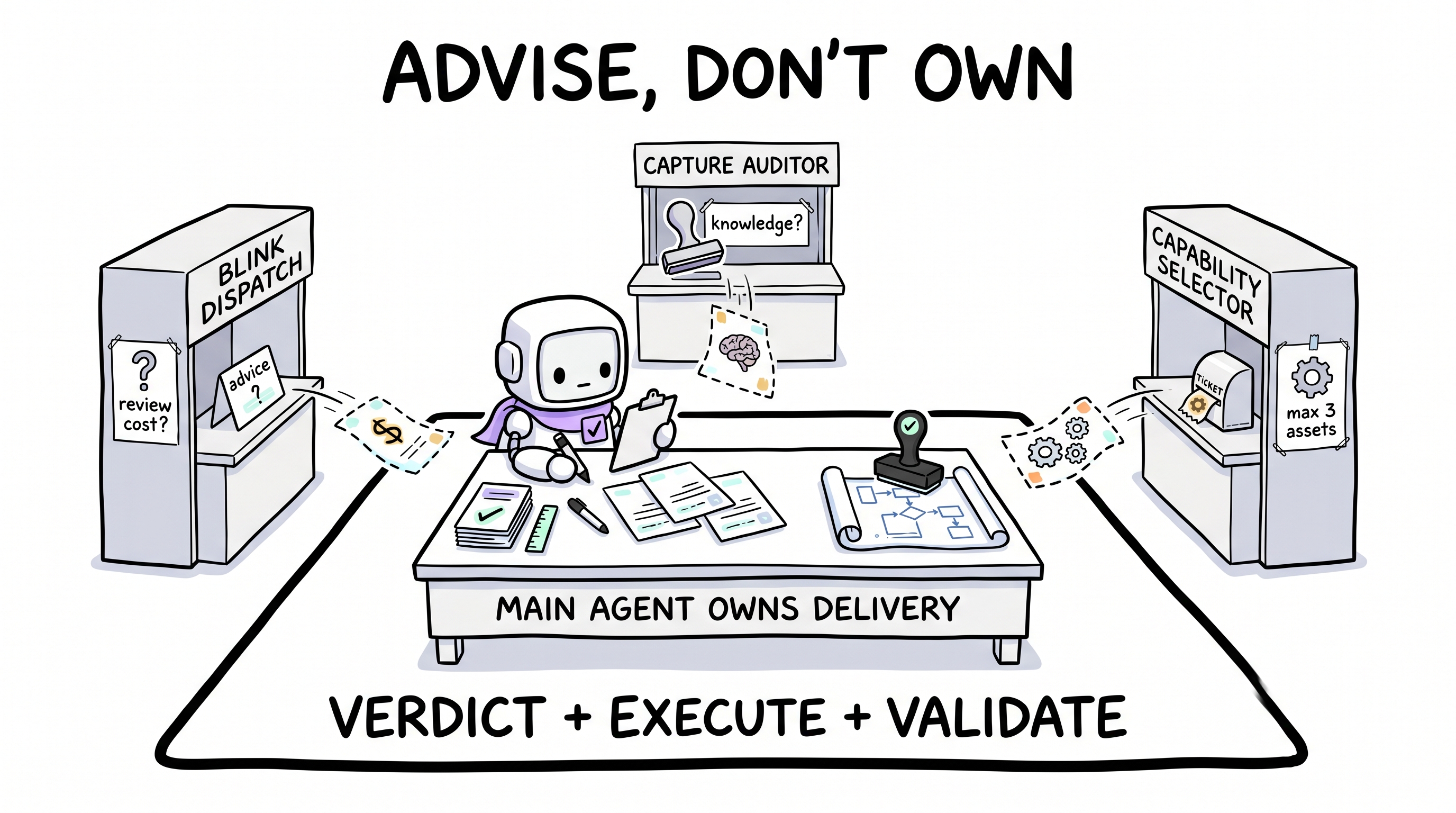
One of Archon's core architectural principles: Execution and judgment must be separated.
The main agent remains the project owner. Blink Dispatch decides whether close-out needs capture-auditor; drift/manual review launches archon-reviewer; broad capability/toolset requests may launch a read-only selector subagent to return a compact asset-selection packet before the main agent loads full skills or tool cards. Sub-agents advise, audit, or summarize selection; they do not take ownership of the delivery.
Delegation Threshold & Cost Awareness
See soul/delivery.md §Lifecycle Hooks for the complete delegation criteria and cost awareness principle. Key rule: mechanical checks stay as self-audit; judgmental assessments (knowledge value, bias correction) warrant delegation.
Capability selection is a context-budget delegation, not a lifecycle gate or exported agent file. Use a generic read-only subagent only after Verdict=proceed when Level 1 domain-tool metadata plus manifest/platform skill metadata point to multiple plausible candidate assets, or when reading full candidate assets would crowd the main agent's working context. The selector's output is advisory; the main agent still performs the Verdict, loads the chosen assets, executes the delivery, validates the result, and closes out.
State Management
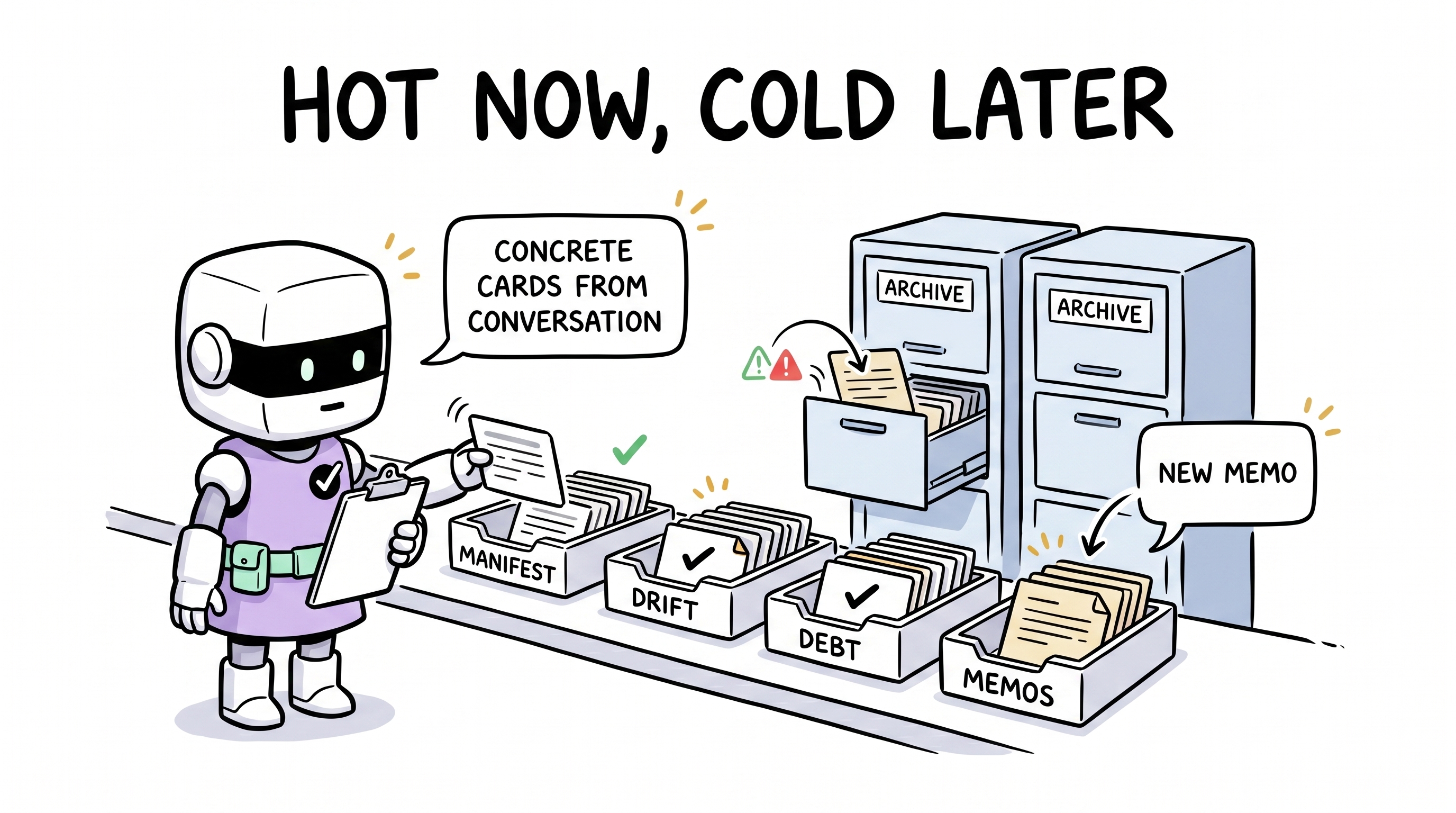
Archon manages project state through three living files, auto-updated after each delivery.
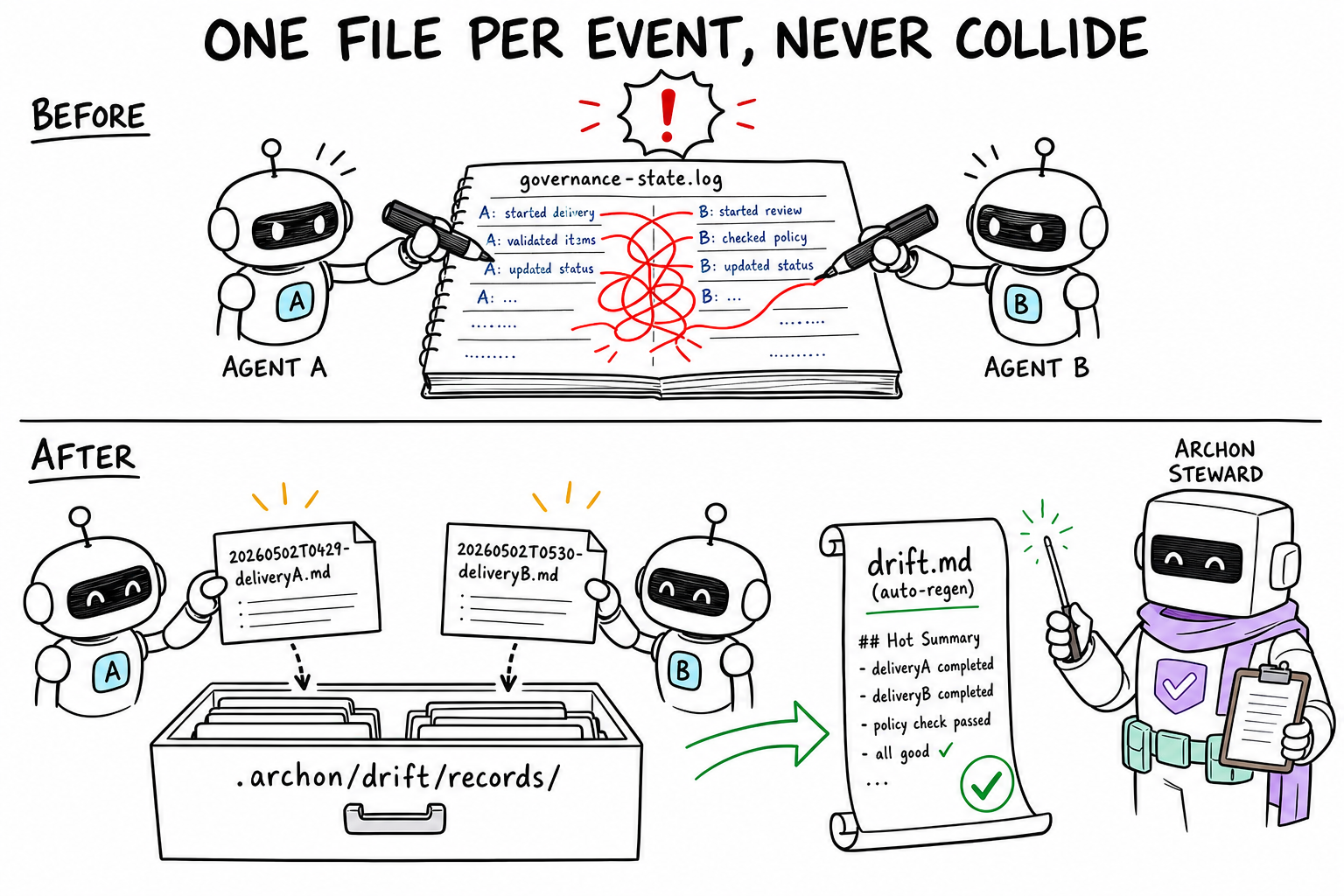
Per ADR-22 records-folder, the three event-stream state files (drift.md / memos.md / debt.md) are hot summaries auto-generated from per-event records under:
| Hot summary | Records source of truth | Sentinel sections | Helper command |
|---|---|---|---|
.archon/drift.md | .archon/drift/records/<ISO8601>-<slug>.md | current-value, log | node scripts/archon-records.mjs new drift --type delivery --delta +N --summary "..." then regen drift |
.archon/memos.md | .archon/memos/records/<ISO8601>-<slug>.md | hot-memos | ... new memos --topic "..." --conclusion "..." --source "..." then regen memos |
.archon/debt.md | .archon/debt/items/DEBT-NNN-<slug>.md | active-debt | ... new debt --id DEBT-NNN --severity ... --status pending --deadline ... --source "..." --summary "..." then regen debt |
Hot rows between sentinels are never hand-edited: a new record file is created, then npm run archon:records:regen <kind> rewrites the hot summary deterministically. npm run validate fails red if a hot summary disagrees with its records folder.
This solves the concurrent-PR conflict that single-file append-only governance state hits as soon as multiple cloud agents work in parallel: different branches write different filenames (no textual conflict); after merge the regenerator computes a unique hot summary (no integer-counter ambiguity, no Threshold: X→Y non-commutative narrative).
The single-file representation below remains the conceptual model of state; the records-folder is its physical implementation:
manifest.md — Project Hot Context
| Section | Content |
|---|---|
| Product | Product definition, core flow, business model |
| Concept Glossary | Product-specific terminology (term + project meaning + ≠ common meaning) |
| User Language Index | Stakeholder phrases, aliases, and nicknames mapped to canonical project artifacts. Row format: User Phrase(s) ·-separated · Canonical Target = artifact class + identifier · Lookup = route · file · anchor pointers. Disambiguation rule: when phrases resolve to different targets, create separate rows rather than merging. /archon-demand Pre-Scan consults this section on every demand (see §Stakeholder Memory) |
| Tech Stack | Frameworks, versions, dependencies |
| Validation Command | Concrete lint + typecheck + test command |
| Git Strategy | Commit mode (auto/prompt/off) + branch model |
| Directory Structure | Complete file tree |
| Knowledge Asset Index | Index of all rules/skills/ADR |
| Milestones & Acceptance | Hard acceptance criteria — all checked = complete |
| Current State | Active milestone + known issues + compact latest review pointer |
| Stakeholder Memos | Pointer to .archon/memos.md hot index |
Long latest-review detail belongs in .archon/manifest/archive/<year>-Q<N>.md; keep the hot manifest line concise and retain the latest validation target in Current State. Keep the User Language Index compact: it is a lookup table for repeated stakeholder wording, not a conversation transcript.
Role: Section-scoped current-state source read on the hot path only when the route needs project context. The only archon file allowed to contain project specifics.
drift.md — Cognitive Drift Counter
Tracks the rate at which the agent's cognitive model diverges from project reality. Each delivery scores +1 to +5 based on cognitive complexity, bounded below by mechanical floors (see §Drift Mechanical Floors above). Three-tier triggering replaces the original binary gate:
| Tier | Threshold | Scope |
|---|---|---|
| Light | drift ≥ 6 | Mechanical health audit only (no reviewer sub-agent) · releases 2-4 points · in-session |
| Full | drift ≥ 12 | Original complete flow · reviewer sub-agent · resets to 0-3 |
| Emergency | drift ≥ 20 | Demand intake halted · full + blindspot root-cause + forced remediation plan |
Dynamic thresholds: shift by project phase (build-intensive = higher tolerance; quality convergence = tighter) inferred from manifest Current State without config flags.
See mechanisms/drift-mechanism.md for the complete design rationale.
debt.md — Technical Debt Registry
Deferral = register + deadline. Unregistered = nonexistent = unmanaged. Each item has ID, source, severity, deadline, and status. Before milestone closure, all milestone-close deadline items must be resolved.
debt.md is a hot gate index, not a prose archive. It keeps ID, Severity, Deadline, and Status visible for milestone/review gates; full source, trigger details, and disposition rationale live in .archon/debt/archive/<year>-Q<N>.md.
Stakeholder Memory
Problem solved: session-based frameworks' inherent flaw — every boot starts from a blank slate. A project owner should remember what was discussed with the stakeholder. The same question asked twice = the first conclusion was lost = a failure of ownership.
Memory Architecture
Example: if a stakeholder asks about a large architecture migration and Archon rejects it with rationale, close-out stores the conclusion as a memo. A later session pre-scans memos, recalls the prior decision, and avoids making the user repeat the same context.
Three-Layer Implementation
| Layer | Location | Responsibility |
|---|---|---|
| Principle | soul.md §Ownership | "The user should never repeat themselves — repetition = lost context = failure" |
| Entry | archon-demand §Pre-Scan | After receiving demand, search memos, decision records, and the manifest User Language Index for stakeholder aliases; hit → silently resolve (optionally bridge "We call this X in our project.") and proactively cite history; near-miss → record uli_candidate: <phrase> → <target> for Close-Out promotion |
| Exit | archon-demand §Close-Out step 7 | Write conclusions with decision value to memos (rejection/deferral/direction confirmed/priority change) |
| Storage | .archon/memos.md + memos-archive/ | Hot index: compact pointers; archive: full rationale with Archived On |
Memory Classification
Different memory types have different persistence vehicles. Stakeholder memos are a lightweight hot index backed by cold archives; heavyweight decisions are promoted to stronger vehicles:
| Type | Vehicle | Lifecycle | Loaded at Boot? | Example |
|---|---|---|---|---|
| Delivery record | drift.md | Compressed by cycle | Yes | "Quality gate passed; release pressure reduced" |
| Project architecture decision (positive) | .archon/decisions.md (ADR) | Permanent | On demand | "Use managed database platform for first milestone" |
| Project architecture decision (negative) | .archon/decisions.md (Negative ADR) | Permanent (with re-evaluation conditions) | On demand | "Reject full framework migration until evidence changes" |
| Framework architecture decision | docs/archon/decisions.md | Permanent | On demand | ADR-20 Archon-native Evolution Loop |
| Stakeholder conclusion (hot) | memos.md | ≤5 compact pointers | Section-scoped | "Migration rejected", "localization deferred" |
| Stakeholder conclusion (cold) | memos-archive/<year>-Q<N>.md | Quarterly partition · archived forever | No — keyword-matched, on-demand | Older auth-boundary decisions |
Trimming, Cold Archive & Promotion
Memo hot cap: 5 compact entries. Full rationale migrates to memos-archive/<year>-Q<N>.md (NOT deleted). Each archive file carries a keyword index at the top; demand pre-scan scans the keyword index (NOT full body) and loads the archive file in full only on keyword hit.
Before migration, check:
- Conclusion has durable long-term value across projects? → Promote to a stronger vehicle (ADR / skill / manifest section), then archive
- Conclusion is stale or superseded? → Archive with a
superseded by <target>note
Memory Layer Consolidation (Reverse Crystallization)
Crystallization moves new knowledge into assets (trigger table). Consolidation moves accumulated knowledge into stronger vehicles; runs during full review as Phase 4 and the reviewer sub-agent's §Framework Completeness step.
| Source Signal | Consolidation Target |
|---|---|
| Resolved debt with generalizable fix path | New or updated skill |
| Drift log pattern recurring ≥3 times in cycle | ADR or editor rule |
| Stable memos referenced by ≥3 deliveries | Manifest section or ADR |
| Archive memos recalled ≥2 times in quarter | Promote back to hot memos or to manifest |
Design Boundaries
- Is: Conclusion-level memory — what was discussed, when, what was decided, why
- Is not: Conversation-level memory — does not store conversation flow (that's the agent transcript's job, retrievable on demand)
- Is not: Full history — routine delivery records are carried by drift; memos record only conclusions with decision value
- Enforcement: Process-level (demand step), not mechanical (cannot lint-detect omissions). Consistent with L3-L5 constraint pyramid levels — relies on the executor reading and following
Anti-Bloat Mechanisms
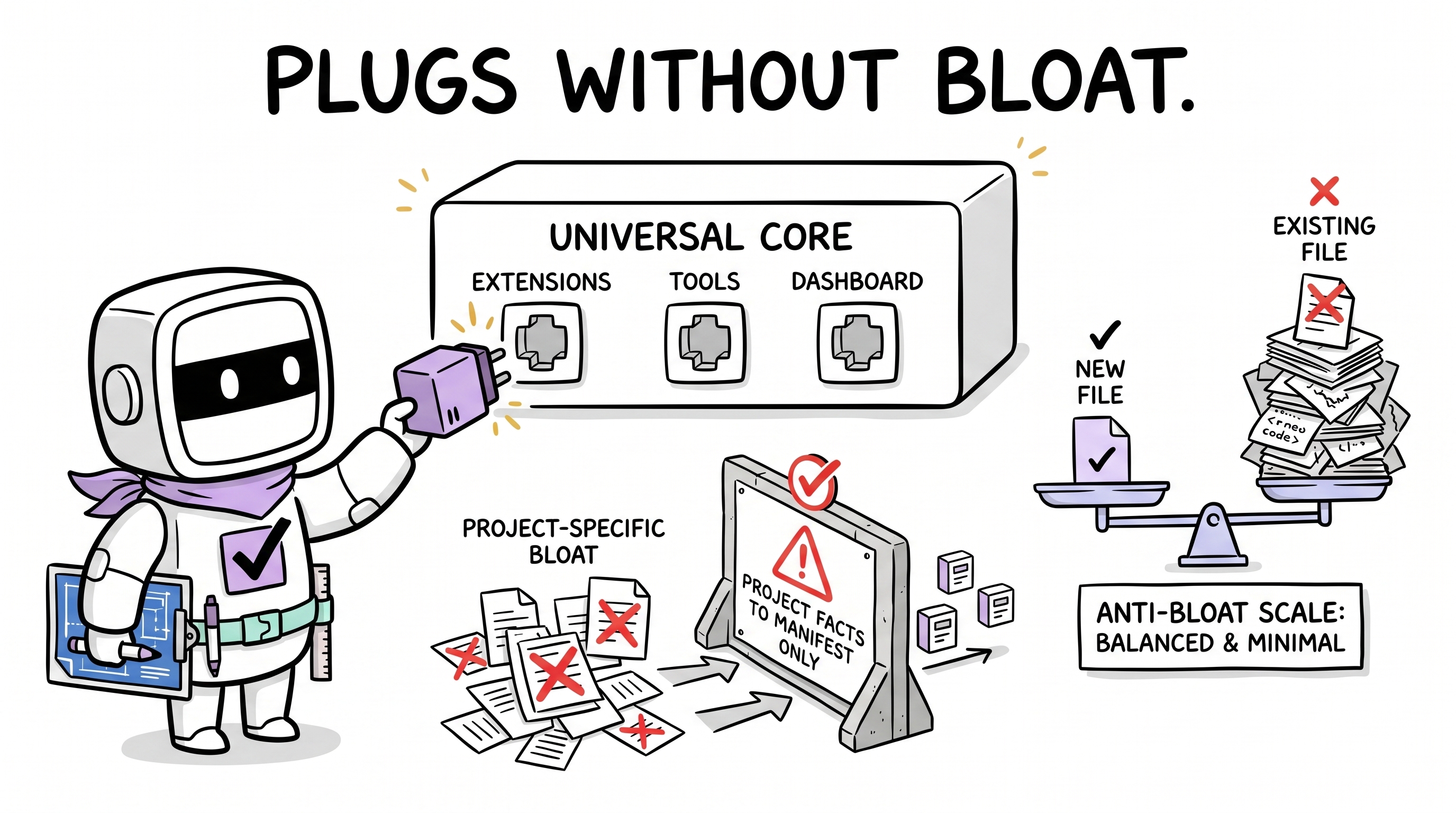
Archon's governance files can bloat too. Four lines of defense:
| Defense | Mechanism | Timing |
|---|---|---|
| Pre-emptive | Justify creation: must answer "can an existing file carry this?" before creating | On creation |
| Pre-emptive | Governance ratio bounds: governance files / source files within [0.1, 0.5] · asserted in governance.test.ts | Ongoing (ratio lower bound catches tribal knowledge) |
| Pre-emptive | Context budget table: per-file hard line caps declared in manifest.md §Context Budget · asserted in governance.test.ts | Ongoing |
| Retroactive | Bloated → split; redundant → merge; stale → delete | During review |
| Automated | Drift log compression: move old complete rows to archive when hot file exceeds 70 lines | During review |
| Automated | Memos cold archive: full rationale migrated to memos-archive/<year>-Q<N>.md rather than deleted | On hot cap breach |
Claim Verification — "said vs truth" family (ADR-27)
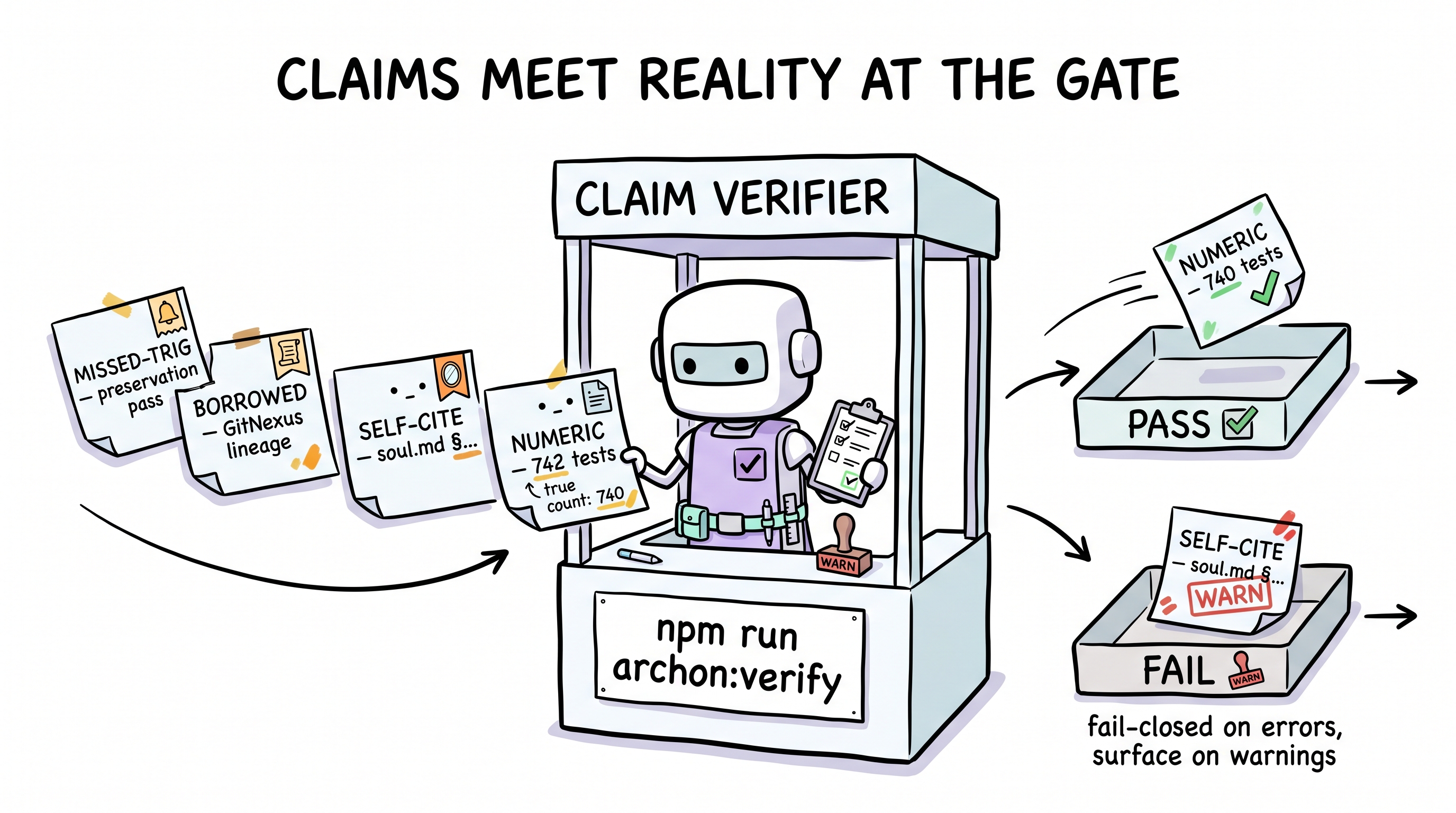
Governance prose can quietly drift from the repo: a test count cited from memory, a borrowed concept without lineage, a soul edit that cites itself, a trigger that fires silently. Per ADR-27, a single verifier scripts/archon-claim-verifier.mjs carries four modes under one unified [claim-verifier:<mode>] <FAIL|WARN>: <file> — <msg> report format:
| Mode | Catches |
|---|---|
numeric | Numeric claims in governance docs or skill prose that disagree with the repo (e.g., test count, file count, bundle size) |
borrowed | Borrowed-concept statements in ADRs or drift rows missing the lineage line (which external sample, which commit) |
self-cite | Edits to soul.md / soul/*.md that cite themselves as authority without an independent source |
missed-trig | Close-Out claims a trigger fired without the corresponding evidence in drift or records |
preservation | none-this-cycle(<evidence>) on the Close-Out Preservation row without a substantive scanning verb + scan target (≥40 chars), and first-pass-degeneracy bootstraps that pin same-delivery anchors without explicit "first pass / introducing delivery" framing |
The verifier is wired into npm run validate (errors fail closed, warnings surface) and the pre-commit hook. The portable archon-check.py remains the adopter-side contract checker; the verifier is the per-delivery scan at authoring time — the two do not duplicate each other.
Self-Reflection Mechanisms
Archon governs not just code, but itself. See soul/review.md §Reflection & Proactive Scrutiny for the full mechanism: recursive principle application, four mandatory proactive questions, known blindspot patterns table.
Modular Soul Loading
The cognitive core is split into one section-scoped core + two mode-specific extensions to keep the perpetual context tax low while preserving full specification depth per mode.
| File | Content Scope | Loaded By | Budget |
|---|---|---|---|
soul.md | Ownership · Core Axioms · Guardrail System · Knowledge Hygiene · Evolution (incl. Preservation Axis per ADR-28) · Persona · Sub-Agent Independence (universal principles) | Boot and mode hot paths by required section | 310 lines |
soul/delivery.md | Reasoning Capsules · Lifecycle Hooks · When to Escalate · Delivery Fast-Path · Debt Tracking · Product Quality | /archon-demand only | 150 lines |
soul/review.md | Reflection & Proactive Scrutiny · Review Tiering · Memory Layer Consolidation | /archon-plan and /archon-review | 150 lines |
Why split: soul.md carries universal judgment, but the hot path should read only the sections needed for the current route. Chapters only used by one mode (delivery lifecycle · review reflection) become per-mode extensions. Measured impact from the original split: boot path cut ~40% · demand path ~12% · plan/review path ~23%; section-scoped hot reads reduce the steady-state tax further without weakening the specification.
Anchor integrity: governance.test.ts § Soul anchor consistency scans every soul[/delivery|review].md §X reference in commands, agents, and extensions, asserting each anchor resolves to a real heading. Refactoring the core or extensions automatically fails this check until cross-references are updated.
See ADR-10 in the decisions log for the full rationale.
Decoupling Model
Archon's universal files can be copied directly into any new project:
| Portable File | Role | Contains Project Specifics? |
|---|---|---|
| soul.md | Cognitive core (section-scoped hot path) | ❌ |
| soul/delivery.md | Delivery-mode extension (loaded by demand) | ❌ |
| soul/review.md | Review-mode extension (loaded by plan + review) | ❌ |
| archon.md (command) | Unified entry + intent routing | ❌ |
| archon-wake.mdc (rule) | Wake trigger | ❌ |
| archon-demand/plan/review.md | Workflows | ❌ |
| archon-reviewer/capture-auditor.md | Sub-agents | ❌ |
| archon.mdc | Decoupling rules | ❌ |
| drift.md rules section | Drift mechanism | ❌ |
| manifest.md | Project context | ✅ The only one |
| drift.md log section | Delivery records | ✅ |
| debt.md registry | Tech debt | ✅ |
Rule: Universal files must not contain concrete technology names, file paths, shell commands, package names, or metric numbers. See the archon decoupling rules in the platform rules directory.
Extension Points
Archon's core lifecycle exposes fixed extension points — project-specific capabilities hook into these points without modifying core files. This is the plug-in mechanism: install by creating a directory, uninstall by deleting it.
Architecture
The universal core exposes fixed sockets; project-specific extensions plug into those sockets without changing core files. Extension names stay outside the universal core.
Lifecycle Points
Commands scan .archon/extensions/ at these fixed points. Each extension declares which points it subscribes to:
| Point ID | Command | When | Available Context |
|---|---|---|---|
demand.pre-scan | archon-demand | After loading memos, before decision gate | Demand text, memos, manifest |
demand.close-out | archon-demand | After stakeholder memos, before git | Delivery summary, verdict, changed files |
plan.perception | archon-plan | During state perception phase | Manifest, debt, drift |
plan.output | archon-plan | After priority ranking, before final output | Ranked work items |
review.health | archon-review | During knowledge health audit | All project files |
Presence = active. Absence = not installed. Max 3 active extensions, ≤15 lines per hook. See soul.md §Extension Points for the complete specification: discovery protocol, file format, budget rules, and design rationale.
Other Extension Patterns
Adding a Workflow Mode
Create archon-<mode>.md in the commands directory:
- Open by declaring the required soul/manifest hot-path sections
- Define mode responsibilities
- Close with manifest + drift updates
New modes are automatically covered by the wake layer — archon.md routing logic and archon-wake.mdc trigger can extend their intent mapping tables to recognize new modes.
Adding a Sub-Agent
Create an agent file in the agents directory. Follow:
- Pass delegation threshold + cost awareness evaluation
- Sub-agent advises; main agent executes
- Output is structured and auditable via drift log
Adding Knowledge Assets
- Rules (platform rules directory): Conventions enforced during editing
- Skills (platform skills directory): Domain knowledge indexed on demand
- Follow the constraint pyramid: push to the strongest possible level
Adding Tools
Create a tool subdirectory in the archon directory. Tools are read-only observability extensions or utility scripts — they do not alter the core Archon workflow.
Current tools:
- Dashboard (
.archon/dashboard/): Schema-first governance state dashboard.schema.jsdefines file structure and drives parsing + validation;server.jsrenders workflow-driven visualization pages. Session heartbeats are injected via the heartbeat rule — dashboard directory exists = activated, removed = deactivated. Structural validation integrated intogovernance.test.ts; file format drift = red test.
Feature Overview
| Category | Feature | Summary |
|---|---|---|
| Identity | Ownership model | Agent = Owner, not Assistant |
| Identity | 5 Identity Axioms | Ownership · Constraints · Inference · Lean · Separation |
| Cognitive | Cognitive loop | Perceive → Model → Act → Verify (backtrack at any stage) |
| Entry | Wake mechanism | Rule trigger layer + Command routing layer + Executor layer (three-tier separation) |
| Entry | Dual channel | "hi archon" (natural language) / /archon (explicit command) / /archon-* (direct) |
| Entry | Intent routing | Auto-dispatch plan/demand/review + drift pre-check |
| Governance | Delivery lifecycle | 9 close-out steps + extension hooks + version control + threshold events |
| Governance | Fast-path | Qualified trivial deliveries collapse ceremony; abuse detected via share>60% check |
| Governance | Decision gate | Should it be done / how big / who decides (structured as Verdict output, previously GATE-1) |
| Governance | Plan-mode binding | Verdict precedes any write-side tool; Cursor Plan mode is the platform realization (ADR-11) |
| Governance | Convergence gate | Milestone-scoped demand filter — out-of-scope demands rejected unless exempted or user-overridden (ADR-12) |
| Governance | Validation gate | lint + typecheck + test — red means fix to green |
| Governance | Close-out gate | Close-Out structured checklist (previously GATE-2) — auditor verifies compliance |
| Governance | Drift counter | Quantify cognitive debt + mechanical floors + dynamic thresholds (convergence phase tightens emergency to 14) |
| Governance | Tiered review | Light (≥6) / Full (≥12) / Emergency (≥20; convergence phase ≥14) — releases pressure continuously |
| Governance | Debt registry | Structured debt tracking + milestone gate |
| Quality | Constraint pyramid | L0-L5 six-level constraints — push to strongest |
| Quality | Constraint maturity | SHOULD → MUST upgrade path |
| Quality | Lint-Rule bridge | L1 actively triggers L2 |
| Quality | Anti-rationalization table | Red Flags embedded in skills for immediate correction |
| Quality | Systematic debugging | Four-phase root cause analysis + reasoning capsules |
| Evolution | Knowledge capture | Trigger table + crystallization path |
| Evolution | Preservation axis | Pin load-bearing rules so edits-elsewhere cannot drain them (ADR-28) |
| Evolution | Reasoning capsules | Symptom → root cause → fix, embedded in skills |
| Evolution | Recursive application | Soul principles constrain Archon itself |
| Evolution | Proactive scrutiny | Five mandatory questions in plan/review |
| Evolution | Known blindspot patterns | Pattern recognition + bound countermeasures |
| Memory | Pre-scan | Search memos and decisions before acting; hit → proactively cite |
| Memory | Concept Glossary + User Language Index | Product-specific vocabulary and stakeholder aliases included in current-state hot paths; prevents semantic drift on domain terms and artifact lookup |
| Memory | Stakeholder memos (hot) | ≤5 compact pointers to stakeholder conclusions |
| Memory | Cold archive | Trimmed memos migrated to memos-archive/<year>-Q<N>.md · keyword-matched on-demand recall |
| Memory | Negative ADR | Rejected architecture proposals persisted (with mechanical re-evaluation triggers) |
| Memory | Trimming & promotion | Oldest entries archived or promoted to stronger vehicles |
| Memory | Layer consolidation | Reviewer Phase 4: promote accumulated knowledge (resolved debt → skill; recurring drift → ADR/rule; stable memos → manifest) |
| Delegation | Execution-judgment separation | Sub-agent advises, main agent executes |
| Delegation | Cost awareness | Mechanical checks self-audit; judgmental checks delegated |
| Delegation | Model-family separation | Sub-agents declare model_family: different-from-main · manifest assigns per role |
| Decoupling | Universal core | soul/commands/agents portable to any project |
| Decoupling | Project-state binding | Project specifics belong in project-state files such as manifest, drift logs, debt, memos, and project ADRs |
| Extensibility | Extension Points | 5 lifecycle hooks in core; project-specific extensions plug in without modifying commands |
| Extensibility | Pluggable install | mkdir = install, rmdir = uninstall, Status: disabled = pause |
| Extensibility | Budget constraints | Max 3 active extensions, ≤15 lines per hook, not exported with core |
| Extensibility | Extension lifecycle | Promotion (≥2 projects OR 15-line hook budget hit → core via ADR) · Deprecation (3 idle cycles → removal logged in drift) |
| Hygiene | Anti-bloat defenses | Creation justification + budgets + automated gates |
| Observability | Dashboard | Schema-first parsing + workflow-driven layout + SSE live updates |
| Observability | Heartbeat protocol | Rule-injected session state; dashboard presence = activated |
| Observability | Structural guards | Governance file schema validation integrated into governance.test.ts |
Related Documents
| Document | Content |
|---|---|
| README.md | Quick start navigation |
| setup.md | Full setup steps for new projects |
| mechanisms/drift-mechanism.md | Deep dive into drift mechanism design |
| decisions.md | Archon framework ADRs (portable mechanism rationale) |
| user-journeys.md | 15 real-world pitfalls of AI-assisted coding → Archon mechanism mapping |
| concepts/model-vs-harness.md | The "Model vs. Harness" debate: why stronger models still need engineering environments |
| concepts/superpowers-comparison.md | Comparative analysis with Superpowers |